




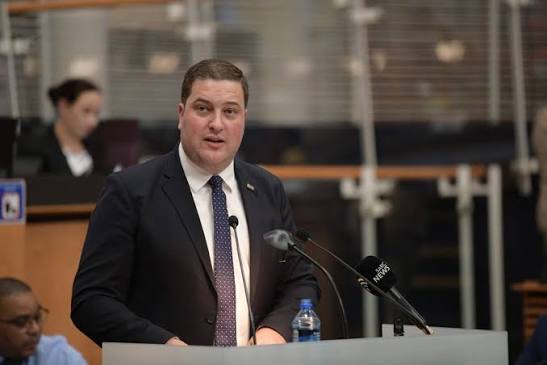
DA leader and Cape Town mayoral candidate Geordin Hill-Lewis has announced plans to establish South Africa’s first Metro Police Detective Branch if re-elected in November, saying the move is needed to address gaps in crime investigations caused by vacant SAPS detective posts.
Speaking during the DA’s Stronger Policing Pledge march in Delft on Wednesday, Hill-Lewis said the proposed unit would recruit, train and deploy dedicated Metro Police investigators to focus on gang violence, firearms and drug-related crimes.
The announcement comes after four people, including a 13-year-old boy, were murdered in Zandkloof Street, Delft, three months ago. Hill-Lewis said no arrests had been made.
“I want to say this plainly: the tragedy that happened here was not inevitable. It was not bad luck. We must never, ever accept that this is ‘just how things are’ on the Cape Flats,” he said.
Hill-Lewis said crime investigations were being affected by a shortage of detectives, claiming there were close to 200 vacant detective posts across Cape Town police stations.
“This is the result of a police service that does not have enough detectives to investigate the crimes committed against you,” he said.
He added that the vacant posts meant cases involving serious crimes, including gang murders, rapes and robberies, were not progressing as quickly as they should.
Hill-Lewis said he had repeatedly called for the devolution of policing powers to capable Metro Police services, arguing that municipalities should be allowed to assist the SAPS with investigations.
“As Mayor, I’ve now worked with three different Police Ministers. Each time we’ve asked for the same thing: give investigative powers to Cape Town’s Metro Police so that we can help SAPS investigate violent crimes, and make sure we actually get convictions,” he said.
He accused the national government of failing to act on the request.
Play Video
“The fact is our national government is not serious about winning the war on crime. We are serious,” Hill-Lewis said.
He said the proposed detective branch would be established if voters supported the DA in November.
“With your support in November, we will build South Africa’s first Metro Police Detective Branch,” he said.
Hill-Lewis said investigators would focus on building stronger criminal cases by gathering evidence and preparing dockets.
“We will recruit, train and deploy dedicated Metro Police investigators to work on gang violence, firearms and drug-related cases. Building the dockets, gathering the evidence, and doing the proper police work that turns an arrest into a conviction,” he said.
He said the plan would begin immediately after the election.
“This is not a pilot. This is not a promise for some distant future. We start doing this the day after this election on 5 November,” Hill-Lewis said.
What the SAPS Act says
Section 64E of the South African Police Service (SAPS) Act 68 of 1995 sets out the functions of municipal police services.
The Act states that municipal police services are responsible for traffic policing, enforcing municipal by-laws and regulations, and preventing crime.
However, criminal investigations and detective functions are not listed among the functions of municipal police services under the Act. The investigation of criminal offences remains a function of SAPS.
Any move to establish a municipal detective capability would therefore require operating within the current legal framework or changes to legislation.
Hill-Lewis said he expected objections that policing remained a national responsibility, but argued that Cape Town could no longer wait for the SAPS to address detective shortages.
“They will say policing is a national competency. They will say the city has no business building a detective capability,” he said.
“And to them I say: we will no longer wait for SAPS to start doing its job. Because for years, this city has asked, formally and repeatedly, for the power to help SAPS close this gap.”
He said the city was prepared to challenge the issue in court if necessary.
“If we have to, we will go to court to force the issue – because the Cooperation Agreement between this city and SAPS was signed in good faith, and it is time SAPS and national government were held to it,” he said.
Hill-Lewis said the city had already expanded its Metro Police force by more than 1,300 officers during his term and said the proposed detective branch would strengthen crime-fighting efforts.
He said the aim was to ensure crimes were properly investigated and offenders were held accountable.
“And now, with your support, a detective branch that investigates crime, and a fight for the power to do that so that each crime is investigated and every criminal knows they will not get away with it,” he said.
City says it wants expanded powers to build detective capacity
Speaking to IOL News, the City of Cape Town said it was seeking expanded lawful powers of criminal investigation to build on its existing Safety and Security Investigations Unit (SSIU) and develop it into a fully-fledged detective service.
The City said the SSIU currently investigates matters including firearm, drug and metal theft-related crimes, attacks on City frontline workers, vandalism and theft of public infrastructure, gang activity in City affordable rental units, and internal investigations within the Safety and Security directorate.
However, these investigations must currently be handed over to the SAPS.
The City said expanded powers would allow municipal officers to build stronger cases before they are handed to prosecutors.
“With expanded policing powers of criminal investigation, the main objective would be to build prosecution-ready dockets to gain more convictions, especially for gang, gun and drug crime,” the City said.
Addressing concerns about the legal framework, the City said it believed limited changes would be required to allow municipal police to take on additional investigative responsibilities.
“Minimal change is required to the current legal framework – with the necessary will powers for municipal police can be expanded within months,” the City said.
It said this could be achieved through regulations under the SAPS Act and, where necessary, amendments through Parliament.
The City also stressed that the proposed detective branch would not replace SAPS but would work alongside the police service and the National Prosecuting Authority.
“Importantly, the City doesn’t seek to replace or compete with SAPS, but rather for our officers to have expanded powers to work with SAPS and the NPA to build prosecution-ready case dockets and deliver more convictions for specific crimes, especially gang, gun and drug crime,” the City said.
The City said Metro Police officers were already being prepared for possible expanded responsibilities through training that includes statement taking and evidence handling.
It said the move was aimed at improving outcomes in cases involving firearms and drugs, adding that Metro Police officers confiscate more than 400 illegal firearms annually.
The City said that currently, firearms handed over to SAPS often do not result in convictions, claiming that only 5% of these cases end in a conviction.
It said expanded investigative powers would allow officers to follow the full chain of investigation, from gathering evidence to preparing cases for prosecutors.