



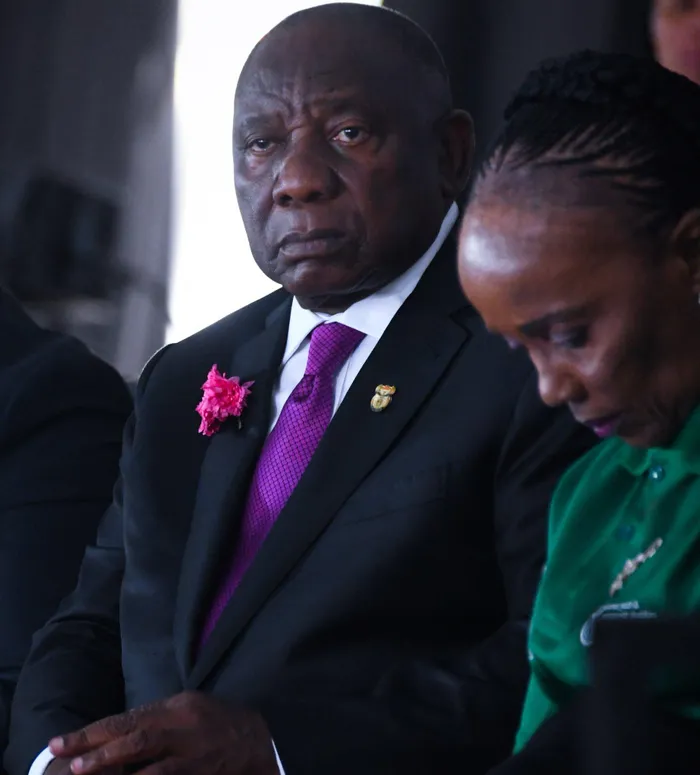
Kabul got a bloody nose at the Union Buildings on Sunday, with President Cyril Ramaphosa condemning the exclusion of Afghan women from classrooms, workplaces and public life.
Ramaphosa was delivering the keynote address at the commemoration of the 70th anniversary of the 1956 Women’s March, held this year under the theme “empowered women empower nations”.
Nobel peace prize winner Malala Yousafzai was the guest of honour and also addressed the commemoration.
Yousafzai was 15 when the Taliban shot her in the head on her school bus in Pakistan’s Swat Valley in 2012, for insisting that girls be allowed to go to school.
Yousafzai, who won the Nobel prize two years later, said the women of 1956 had inspired her own campaigning, and that their example was the reason she had now come back to South Africa.
Afghanistan is the only country in the world that forbids girls from attending secondary school.
The Taliban imposed the ban in September 2021, a month after seizing power as the last US troops left, and extended it to universities in December 2022.
UNESCO counts about 2.2 million Afghan girls now out of the classroom because of it, and have recorded more than 70 decrees restricting the rights of women and girls since 2021.
The United Nations Children’s Fund (UNICEF) warned in April that Afghanistan stands to lose more than 25,000 women teachers and health workers by 2030 if the restrictions remain, and that women’s share of civil service jobs had already dropped from 21% to 17.7% between 2023 and 2025.
Ramaphosa said the campaign to silence Yousafzai had produced the opposite result.
“A cruel ideology tried to silence you, but you rose to become one of the most strident voices for the emancipation of women in our world today,” he said.
He said SA extended its solidarity to Afghan women and girls who were being systematically excluded from education, employment and public life.
The pass laws that dictated where black South Africans could live, work and travel were repealed only in 1986, three decades after the women of 1956 marched against their extension to black women.
Ramaphosa said South Africans had lived under a state that used the law for precisely that purpose.
“South Africans know what it means when the law is used to determine where people may go, what they may learn, what work they may do and what place they may occupy in society,” he said.
“No culture, religion, government or ideology can justify reducing women to lesser human beings.
“The freedom of women is indivisible.”
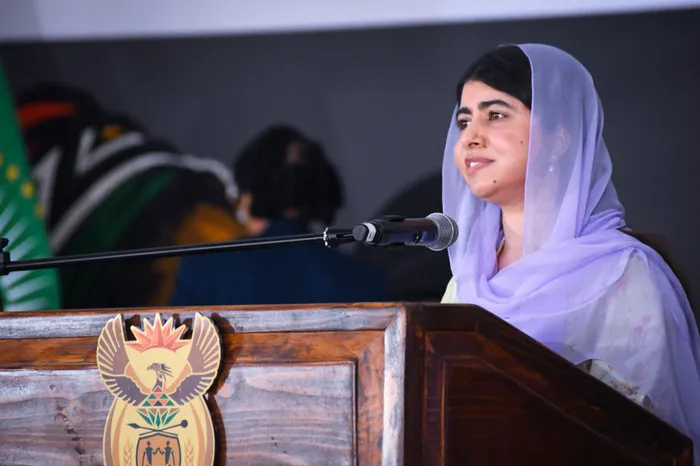
Image: SUPPLIED
Yousafzai said: “It took incredible courage to speak out in 1956, four decades before the end of apartheid and the risks were greatest for black SA women, as they still are today, who faced not only the racial discrimination of apartheid, but the added burdens of being women in a patriarchal society.
“Yet they chose to lead and demanded to be seen. It is their legacy of courage that brings me back to South Africa today.”
She said she had visited Constitution Hill days earlier and had been struck by how much it recalled Afghanistan.
“Afghanistan is a place where women are sent to prison for the same defiance we honour here today,” she said.
“Last year, your government declared gender-based violence and femicide a national disaster in South Africa and introduced programmes and legislation to combat it.
“This year, the Taliban declared it legal for a man to beat his wife or daughter.
“For five years, the Taliban has been erasing women and girls from public life.
“This is not culture. It is not religion. It is a system of segregation and domination.
“We must call the Taliban regime by its true name, gender apartheid.”
Ramaphosa also demanded results from the national disaster his government declared over gender-based violence and femicide.
The classification was made in November last year, after the Women for Change campaign collected more than a million signatures and women across the country lay down for 15 minutes at noon to mark the 15 women murdered in SA every day.
It placed gender-based violence under the same law that governs floods and droughts, unlocking emergency funding and forcing departments to coordinate their response.
UN Women puts the rate at which SA women are killed at five times the global average.
Nine months on, Ramaphosa said the declaration had to start showing something.
“This classification must now produce visible and measurable change,” he said.
He said the killing and beating of women was the work of violent men, and that men and boys had to be part of stopping it.
Ramaphosa said the guilt extended to everyone who stayed quiet about it.
“It is not only the perpetrators of such acts that are guilty. It is also those who choose to look away, to say it’s not their problem,” he said.
“The guilty include those who seek to condone or justify gender-based violence on the grounds of culture, religion or patriarchal social norms.”
He went through the excuses one by one.
“There is no justification whatsoever for sexual harassment, for physical or mental abuse, for rape or for murder,” he said.
“Not how women dress or how they behave. Not because some favour is given.
“Not because they leave a relationship. Not because they are a junior employee.
“Not because they believe themselves equal to men.”
Ramaphosa said SA women had once feared the state, but today many fear the men around them.
“In 1956, women lived in fear of being arrested for not having a pass,” he said.
“Today, women live in fear of the gender-based violence that stalks them in the streets, even in their homes.”
At least 20,000 women gathered on the same lawns on August 9, 1956, to protest against plans to extend the pass laws to black women, who had until then been spared the reference books black men were forced to carry.
They arrived in twos and threes to get around a ban on large gatherings imposed by the authorities.
JG Strijdom, the National Party prime minister who had taken office two years earlier and who drove the removal of coloured voters from the common voters’ roll, did not come out to meet them.
“Prime Minister JG Strijdom chose not to receive them. He ran away,” Ramaphosa said.
The women left petitions bearing more than 100,000 signatures outside his office before standing in silence for 30 minutes.
They then sang “Wathint’ abafazi, wathint’ imbokodo” — “you strike a woman, you strike a rock” — a line that has become the slogan of the day.
“It was a silence more powerful than any speech the apartheid government could have made,” Ramaphosa said.
Sophie Williams-de Bruyn, who was 18 when she joined the march alongside Lilian Ngoyi, Helen Joseph and Rahima Moosa, attended the commemoration.
Ramaphosa said the names of most of the 20,000 women who marched had never been recorded.
He urged families who know of relatives who took part to submit their names to the Write Her into History campaign, run by the Ahmed Kathrada Foundation and the Sophia and Henry De Bruyn Legacy Foundation, which is compiling a record of the marchers.
“Let us complete this roll call of honour,” he said.
He said the women of 1956 had come to fight more than the pass laws, because they also attacked the idea that women belonged at home and had no business in public affairs.
That march followed decades of organised resistance by women, including the 1913 protest in Bloemfontein against passes led by Charlotte Maxeke and the adoption of the Women’s Charter by the Federation of South African Women in 1954.
Ramaphosa said women made up more than half the population but owned only a fraction of the country’s wealth, land and businesses.
He said too many women were unemployed, paid less than men for doing the same work and went unpaid for the work they did raising families and running households.
Ramaphosa said the government was using more of its purchasing power to support companies owned by women.
He said it was also using the Women Economic Assembly, a body he launched in 2021 that negotiates procurement targets for women-owned firms with industries such as banking and motor retail, to open those markets further.
Government was widening women’s access to credit and making sure women held the title deeds to the land they farmed, he said.
More women than men were enrolled at universities and colleges, Ramaphosa said, but too few of them studied engineering, science, technology or a trade.
He said the anniversary would count for nothing unless the outcomes changed.
“The measure of this anniversary will not be the speeches we deliver or the ceremonies we hold,” he said.
“It will be whether a girl can grow up safe, healthy and confident in her future.
“It will be whether a survivor of violence receives protection and justice.”
![Twins on the way, trouble in the past: ‘Pregnant’ Gogo Maweni remains in custody [VIDEO]](https://newsunplug.co.za/wp-content/uploads/2025/01/Gogo-Maweni-2-480x320.png)