



South Africa has spent R292 million on repatriating foreign nationals as part of President Cyril Ramaphosa’s five-point plan to manage illegal migration, with the Home Affairs Department seeking reimbursement from Malawi, Nigeria, and Ethiopia.
Home Affairs Director-General Tommy Makhode told the Portfolio Committee on Home Affairs on Tuesday that the department had written to the Malawian government and the embassies of Nigeria and Ethiopia through the Department of International Relations and Cooperation (Dirco), requesting that they reimburse the costs.
“We have also written to the government of Malawi, and of course the embassies of Nigeria and Ethiopia, requesting a reimbursement of this cost through the Department of DIRCO,” Makhode said.
He said the department was awaiting responses from the respective governments.
The expenditure follows a sharp escalation in South Africa’s migration tensions after Ramaphosa addressed the nation on June 7, announcing a comprehensive five-point approach to migration management.
The plan followed Cabinet’s approval on June 3 and was aimed at enforcing immigration laws, securing the country’s borders, strengthening the immigration system, closing gaps in migration laws and policies, and working with other African countries.
Ramaphosa said the government would intensify the identification and deportation of undocumented foreign nationals, supported by dedicated immigration courts, while also increasing inspections of employers and strengthening border security.
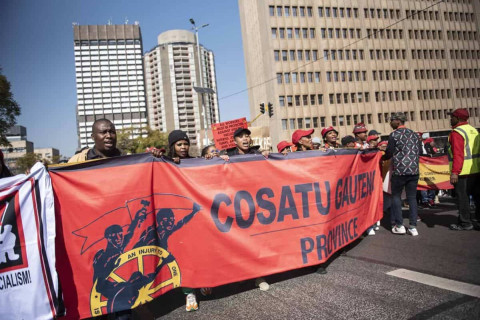
The government’s migration response unfolded against growing anti-immigration protests, including demonstrations organised by March and March on June 30.
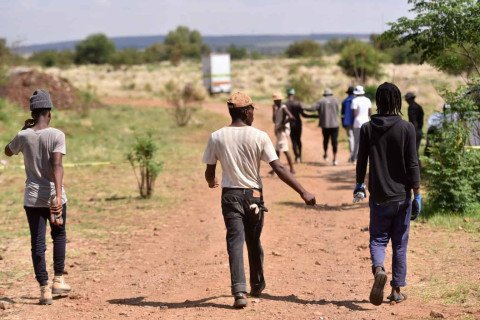
The protests were accompanied by calls for undocumented migrants to leave the country and, in some areas, violence and clashes with police. Thousands of foreign nationals had already left areas where they feared for their safety.
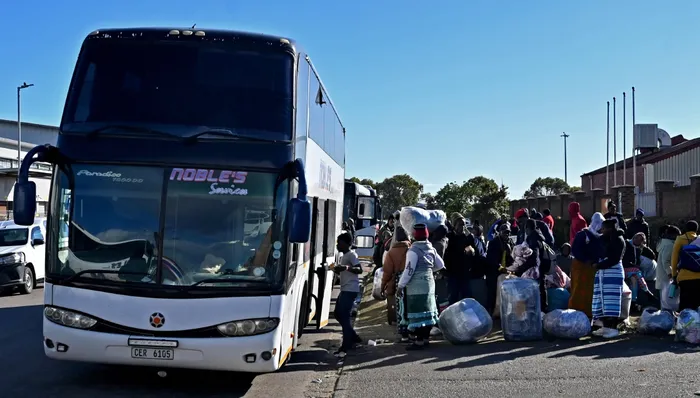
Makhode told MPs that foreign nationals had begun assembling at various sites, including Sherwood Park in Durban, as pressure around migration intensified.
“By the end of June, this situation had become untenable in terms of the numbers, but also the humanitarian emergency that had arisen,” he said.
He explained that the sites were not officially government facilities but were being managed by NGOs and business communities, while government officials verified documentation to facilitate either deportation or repatriation.
Government subsequently established the Temporary Repatriation Processing Centre in Musina, Limpopo, after the Inter-Ministerial Committee on Migration directed that a facility be set up to manage the growing numbers.
Makhode said the centre had been designed to accommodate up to 20,000 people, although its occupancy peaked at about 1,005 and had since declined.
By close of business on August 6, Home Affairs had processed 82,875 people through the repatriation and deportation processes.
Makhode said the figure included people who had been repatriated as well as those who went through the deportation process.
The highest number processed during the peak period was 4,850, while the number had subsequently fallen significantly.
“There are those that were repatriated. There are those that are coming through the deportation,” Makhode said.
He cautioned that the Musina figures did not capture everyone processed because some foreign nationals were processed at other sites and travelled directly to ports of entry.
R292m operation
Makhode described the repatriation operation as an “unfunded mandate” for Home Affairs and other government departments involved.
“This is an unfunded mandate as the Department of Home Affairs and other departments that have been involved in this matter,” he said.
He said Home Affairs had not budgeted for the operation and that repatriation was not provided for in its legislative framework.
Of the R292 million spent, the biggest expense was transport, while the Department of Public Works and Infrastructure had spent R48 million establishing and operating the temporary repatriation centre.
The City of eThekwini and the City of Cape Town also provided transport assistance, with Home Affairs reimbursing eThekwini for its costs.
Makhode said Home Affairs had initially been allocated R60 million but had not anticipated the scale of the operation.
The department had submitted a Cabinet memorandum on the unforeseen and unavoidable expenditure and was also seeking the reprioritisation of funds.
The current financial-year budget for deportations at Lindela was R257 million, but Makhode said the department was expected to exceed that amount because of the increased volume of deportations.
The department has therefore approached the Finance Minister for the reprioritisation of certain budget items.
82,875 processed
Makhode said 44,607 people had been deported through Lindela during the previous financial year, while 16,078 had been deported between April 20 and July 28 this year.
Malawi, Zimbabwe and Mozambique accounted for the largest numbers.
In the previous financial year, 13,479 Zimbabweans and 12,354 Mozambicans were deported. The current financial-year figures stood at 4,095 for Zimbabwe and 4,034 for Mozambique.
Lesotho accounted for 3,495 deportations in the previous financial year and 931 in the current financial year.
The department also recorded deportations involving nationals from countries including Somalia, Bangladesh, Benin, Botswana, Cameroon, Rwanda, the United Kingdom, Vietnam, Algeria, Brazil, Thailand and Liberia.
Dedicated courts process thousands of cases
The government’s migration response has also included the establishment of dedicated immigration courts to speed up the processing of cases.
Makhode said 28,737 cases had been finalised through the dedicated courts.
Gauteng recorded the highest number of cases, followed by KwaZulu-Natal with 4,973. The Western Cape recorded 3,334 cases, while the Eastern Cape had 2,019.
In eThekwini, the Chief Magistrate established seven dedicated courts between June 1 and July 9.
One court operated virtually, with a link to Sherwood, while six operated from Durban Central.
Makhode said the courts finalised 2,173 cases during that period.
Government is also working to expand dedicated court capacity at OR Tambo International Airport and Lindela.
Makhode said the additional capacity was intended to allow immigration cases to be processed “faster and quicker”.
More than 20,000 declared undesirable
The department also reported that 63,090 foreign nationals were declared undesirable during the previous financial year, compared with 20,340 during the current financial year.
Makhode said the declarations included cases involving foreign nationals who had overstayed their permitted period in South Africa.
He said an overstay of 30 days was subject to a one-year ban, while longer periods could result in bans ranging from two to five years.
The department also deals with deportation through Section 34 of the Immigration Act and declarations of undesirability under Section 30.
Makhode said the government’s approach remained grounded in the Constitution, human rights and international obligations.
He said government would not tolerate violence, intimidation, racism, xenophobia, or the blocking of foreign nationals’ access to clinics, hospitals, schools and other public services.
The government has also said the migration strategy must address the regional factors driving migration, with Makhode telling MPs that poverty, instability and limited opportunities in countries of origin would continue to drive migration if they were not addressed.
He said South Africa would use its SADC chairpersonship to raise these issues with countries across the region.