




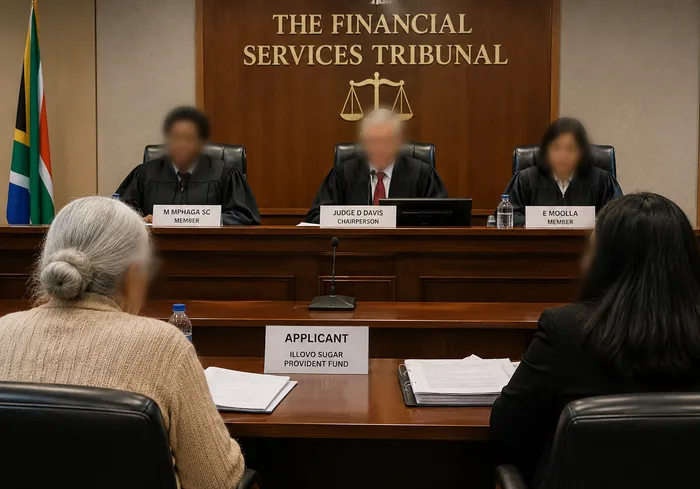
An elderly and illiterate mother has been confirmed as a dependant entitled to a share of her late son’s R5.26 million death benefit after the Financial Services Tribunal found that the Pension Funds Adjudicator had wrongly rejected her claim.
The tribunal set aside the adjudicator’s determination and upheld the original decision by the Illovo Sugar Provident Fund to allocate 10% of the death benefit to Marriema Appanna, the mother of deceased fund member Appanna Gandhi Sanassyi.
The ruling followed a dispute brought by the deceased’s widow, Dorothy Divyashanty Sanassyi, who challenged the decision to include her mother-in-law among the beneficiaries.
The deceased died in January 2021 at the age of 60 after having been a member of the Illovo Sugar Provident Fund since January 1982.
After the addition of late-payment interest and deduction of tax, the amount available for distribution was over R5.26 million.
The fund’s trustees investigated the circumstances of the deceased’s surviving family members and decided to allocate 65% of the benefit to his widow, 25% to his son, Jemuel Jerial Sanassyi, and 10% to his mother.
At the time of her son’s death, Marriemall was about 81 years old according to the initial background, although the tribunal’s later analysis records her as 84. She was illiterate and unable to manage her own financial affairs.
The fund’s investigation found that his son had taken responsibility for managing his mother’s finances because of her age and illiteracy. He regularly paid her municipal rates, electricity and water bills, bought groceries and covered medical and transport expenses.
The investigation also found that Marriemall’s own pension or other income was insufficient to meet her monthly expenses, with the shortfall being covered by her son. The fund concluded that, had Appanna lived, he would have continued supporting his mother because she was unlikely ever to become financially independent.
Sanassyi, however, challenged the 10% allocation before the Pension Funds Adjudicator.
She argued that the assistance her husband provided to his mother was merely administrative and did not amount to financial maintenance or substantive dependency.
She also alleged that her sister-in-law, Jessy, who was also her mother’s caregiver, had inflated the expenses through fraud.
The dispute went through three rounds of adjudication, with the adjudicator repeatedly setting aside the fund’s allocation to Marriemall.
In the first determination, the adjudicator found that there was insufficient evidence of financial dependency and ordered the fund to investigate the issue again.
The fund conducted a further investigation and produced an income-and-expenditure analysis showing that Marriemall’s income did not cover her expenses. The adjudicator nevertheless rejected the allocation a second time, saying that the analysis was not supported by receipts for expenses such as rates, electricity, water and groceries.
The fund then supplied the requested documentary evidence, including municipal rates statements, electricity bills and water bills.
But in a third determination, in September 2025, the adjudicator again rejected the 10% allocation. This time, the adjudicator accepted that the fund had demonstrated Marriemall’s need for financial assistance but found that it had not proved that Appanna had “regularly provided” the support.
The adjudicator also rejected municipal rates statements because they were addressed to the deceased’s father rather than Appanna, and found that the evidence was insufficiently corroborated by Jessy’s evidence.
However, the tribunal strongly criticised this approach.
The tribunal found that the fund had provided precisely the additional proof the adjudicator had requested, but that the basis of the inquiry had subsequently shifted.
The tribunal said the adjudicator had effectively moved the goalposts by first requiring proof of expenses and then, after the fund supplied that evidence, focusing on whether the deceased had personally and regularly provided the financial support.
“The Fund was never given a fair opportunity to satisfy a consistent standard,” the tribunal found.
The tribunal said the evidence, when considered as a whole, overwhelmingly established that Marriemall was a factual dependant of her son.
The tribunal explained that a factual dependant is not limited to a spouse or child. The law also recognises people who were factually dependent on the deceased for maintenance.
It said the test requires evidence that the dependant needed financial support and that the deceased regularly provided that support.
In Marriemall’s case, the tribunal found that the first part of the test was clearly satisfied.
She was elderly and illiterate, her income was insufficient to cover her living expenses, and she depended on her son to manage her financial affairs.
The tribunal noted that even the adjudicator had previously acknowledged that some form of financial support must have existed because Marriemall’s income could not account for all her expenditure.
The tribunal also rejected the argument that the absence of individual receipts for every payment meant that dependency had not been proved.
It said expecting elderly, illiterate mother and her son to maintain formal accounting records for family expenses was unrealistic.
A TEBA report prepared by an independent investigator also confirmed that she was financially and practically dependent on Appanna.
The tribunal further found that the adjudicator had misunderstood the significance of the municipal accounts because they were registered in the name of Marriemall’s late husband.
The important question, the tribunal said, was not whose name appeared on the account but whether the expenses were incurred by Marriemall and whether Appanna funded them.
The tribunal found that the documents established the existence of the household expenses and, when considered together with the other evidence, supported the conclusion that Appanna had been paying them.
The tribunal also held that Marriemall could be regarded as a prospective dependant.
Even if there had been insufficient evidence of past regular support, it found that the circumstances showed she would probably have continued requiring financial assistance had her son survived.
Given her advanced age, illiteracy, fixed income and ongoing living expenses, the tribunal said there was no realistic prospect that she would become financially independent.
The tribunal was also critical of the way the adjudicator dealt with allegations made by Sanassyi against Jessy.
Sanassyi had alleged that Jessy inflated expenses and had made other serious allegations concerning the preparation of affidavits.
The tribunal said those allegations should have been investigated rather than simply accepted and used to discount Jessy’s evidence.
It stressed that the adjudicator’s role includes actively investigating facts and assessing conflicting evidence rather than simply act as a passive referee between the parties.
The tribunal nevertheless stopped short of ordering a final payment figure to Marriemall’s estate.
It found that the 10% allocation amounted to over R526,000 based on the distributable death benefit of R5.26 million.
The tribunal granted the Illovo Sugar Provident Fund’s application for reconsideration, set aside the adjudicator’s September 2025 determination and remitted the matter for quantification.