



South Africa’s youth unemployment crisis worsened in the second quarter of 2026, with nearly two in three young people unable to find work, as economists warned that the country’s jobs crisis is increasingly becoming a skills crisis.
Statistics South Africa’s latest Quarterly Labour Force Survey (QLFS) showed the official unemployment rate rose to 33.6% in the second quarter, from 32.7% in the first three months of the year, as the number of unemployed people increased by 345,000 to 8.5 million. Employment declined by 16,000 over the quarter.
While the headline unemployment rate remains stubbornly high, the figures also highlight the growing premium attached to education. According to Investec economist Lara Hodes, youth unemployment is at a “critically elevated” 62.8%, up from 60.9% previously.
“The youth segment of the market remains the most disadvantaged when it comes to finding sustainable employment,” said Hodes.
Education is key
The QLFS also showed how education increasingly determines employment prospects. South Africans without a matric certificate faced an unemployment rate of 39.2%, while unemployment among graduates stood at just 12.4%.
Those with other tertiary qualifications also recorded unemployment rates well below the national average.
“Access to education remains essential, with the unemployment rate amongst those holding less than a matric certificate at an elevated 39.2%, while unemployment amongst graduates falls sharply to 12.4%,” said Hodes.
Hodes said South Africa had made meaningful progress in implementing reforms to support investment and economic growth, but further reform efforts were needed to generate sustained economic growth and meaningful job creation.
Constrained
PSG senior economist Johann Els said the latest figures pointed to a structural problem that had been decades in the making.
While around 900,000 jobs had been created over the past three-and-a-half years, he said employment growth continued to lag population growth, leaving more South Africans competing for too few opportunities.
“The prospects are improving but it’s not great because the labour market is significantly constrained,” Els said. “We haven’t got the skills we need. We’ve done basically nothing about the education system over the last 30 years to fix the skills deficit.”
Els said employers were increasingly reluctant to hire workers they regarded as unskilled, choosing instead to invest in machinery, equipment and technology.
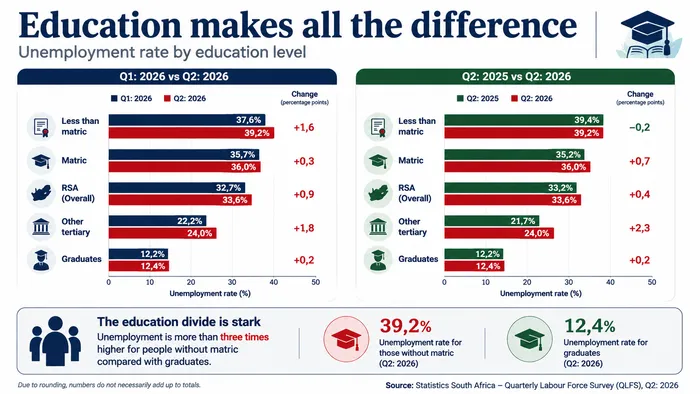
Image: ChatGPT
Lagging peers
The challenge begins long before young people enter the labour market. The 2021 Progress in International Reading Literacy Study (PIRLS) found that South African Grade 4 learners achieved an average reading score of just 288, compared with the international centre point of 500.
This makes the country the lowest-performing participant. More than 80% of learners failed to reach even the study’s lowest international benchmark.
The 2023 Trends in International Mathematics and Science Study (TIMSS) painted a similar picture. While South Africa’s Grade 9 mathematics score improved from 389 in 2019 to 397 in 2023, it remained below the TIMSS low international benchmark of 400.
Science performance declined from 370 to 362, leaving South Africa among the lowest-performing education systems participating in the international assessment.
North-West University academic Dr Paul Iwuanyanwu says South Africa needs a complete science, technology, engineering and mathematics (STEM) ecosystem.
Overhaul
This, Iwuanyanwu said, would comprise of “stronger schools, better-trained teachers, capable artisans and technicians, properly funded researchers, modern infrastructure, and institutions able of converting knowledge into functioning public services”.
Iwuanyanwu added that “STEM education matters because South Africa cannot repair its infrastructure or grow its economy using skills it has failed to develop”.
The education challenge is also reflected in the number of young people disconnected from both learning and work.
Stats SA reported that 36.4% of South Africans aged between 15 and 24 were not in employment, education or training (NEET), limiting their opportunities to acquire the skills employers increasingly demand.