



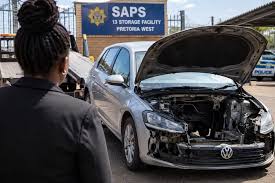
The Minister of Police has been held liable for damages after a woman’s Volkswagen Golf was stripped of its engine while in police custody, with the Gauteng High Court in Pretoria ruling that an indemnity she signed when collecting the vehicle could not be enforced against her in the circumstances.
Acting Judge Jacques Minnaar found that the South African Police Service (SAPS) had failed in its duty to safeguard Suzette Ropafadzo Paradza’s 2014 Volkswagen Golf while it was stored as an exhibit at the SAPS 13 storage facility in Pretoria West.
Paradza instituted a civil claim against the Minister of Police after discovering that her vehicle had been stripped of its engine and that its keys could not be found when she and her husband went to collect it.
Her husband, Selestian Osiele, had bought the vehicle in 2019 or 2020 and gifted it to her.
The vehicle was taken into police custody in May 2022 after Osiele lent it to a friend, Ellen, who allegedly fabricated a hijacking story.
Warrant Officer Warren Timothy Bishop, the investigating officer, testified that he recovered the vehicle in Laudium on May 24, 2022. He said it was in working condition and had an engine, although it had no battery.
A security officer at the SAPS 13 storage facility, Mogadi Mashap Mashala, also confirmed that the vehicle was booked in with its engine fitted.
However, when Paradza and Osiele arrived to collect it in September 2022, they could not locate the vehicle easily and were unable to obtain its keys.
They eventually arranged for it to be towed to a mechanic in Pretoria West.
According to Osiele, the mechanic discovered that the bonnet had been secured with wire and that the engine was missing.
Osiele then contacted Bishop to report the missing engine and returned the vehicle to the police storage facility.
Several components found missing
Paradza’s expert witness, Albert Chibuike, inspected the vehicle approximately three years after it had been booked into police custody.
He found that the engine was missing and that several other components had either been removed or tampered with.
These included the gearbox, water pump, flywheel, alternator, starter and manifold. The bumper had also been pulled off, while the cooler, regulator fan and catalytic converter were missing.
Chibuike testified that removing all the components would take between one and two days and that, in his view, the work had not been carried out by a specialist.
Although the judge did not accept Chibuike’s testimony as expert evidence, she accepted his experience of 29 years in the industry and his evidence about the time required to strip the vehicle.
The court also considered discrepancies in the police records concerning when the vehicle was returned to the storage facility after the attempted collection.
Warrant Officer Kenneth Benjamin Brauns testified that the vehicle was booked back into the system on September 5, 2022, without an engine or gearbox.
He conceded, however, that he could not say precisely when the vehicle had physically been returned, as he had acted on instructions from Captain Hoskins, who did not testify.
The judge found that the evidence supported the conclusion that the vehicle had been returned on September 1, 2022, and that the delay in recording it on the system could explain the difference in dates.
Police failed in their duty of care
The court found that the police had a legal duty to protect property seized or held in their custody.
The court noted that police incur a duty of care over seized goods because such property may have to be returned to its owner when criminal proceedings do not require its continued retention.
The judge said the evidence established that Paradza’s vehicle had an engine when it was taken into police custody but was returned without one.
“The defendant clearly failed in its duty of care in safekeeping the vehicle pending the release to the plaintiff,” the judgment stated.
The judge also criticised the conduct of police personnel at the storage facility, describing their approach to assisting members of the public as lax.
The court heard that Paradza and Osiele had struggled to find the vehicle and obtain its keys when they arrived to collect it.
The judge further noted that the police officer responsible for completing the release documentation had not physically inspected the vehicle before filling in the forms and issuing the exit permit.
Indemnity form does not protect police
A central issue in the case was an indemnity form signed by Paradza when the vehicle was released to her.
The document stated that she had received the vehicle in good condition and sought to exempt the police and the government from liability for claims or losses connected to it.
Police evidence indicated that the documents recorded the vehicle as having an engine, despite the problems encountered when Paradza and Osiele attempted to collect it.
Warrant Officer Ronald Malesela Mashiachidi, who completed the release documentation, testified that he had explained the documents to Paradza. She signed both the vehicle release record and the indemnity.
The judge acknowledged that the indemnity was written in clear terms and that there was no evidence Paradza had been physically compelled to sign it.
However, the court found that the circumstances in which she signed the document were crucial.
Drawing on the Constitutional Court’s ruling in Barkhuizen v Napier, the judge considered whether enforcing the indemnity would be consistent with public policy and constitutional values, including fairness and justice.
The judge concluded that enforcing the indemnity in this case would be unfair and unjust.
Paradza had approached the police to recover her property and received little assistance, while being required to sign various documents. The court found that she was not on an equal footing with the officials responsible for releasing her vehicle.
“It would be unfair and unjust to hold the plaintiff bound to the indemnity,” the judgment stated.
The court concluded that Paradza had established her claim against the Minister of Police.
It ordered the minister to pay her proven damages, as well as the costs of the application.
The amount of compensation remains to be determined in separate proceedings, as the court postponed the assessment of damages indefinitely.