




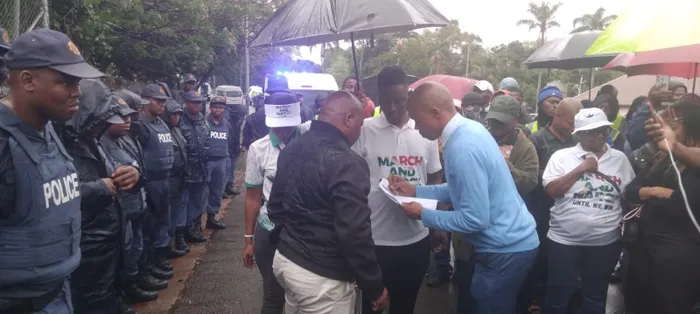
The South African Police Service (SAPS) leadership in KwaZulu-Natal has filed an urgent application in the High Court of South Africa seeking a court interdict against ‘March and March’ as well as several individuals, in a bid to halt unauthorised demonstrations, property destruction, and civil unrest across the eThekwini Municipality.
The urgent legal action, filed under Case No: 2026-266812 in the KwaZulu-Natal Local Division (Durban), names the Minister of Police as the First Applicant and the Provincial Commissioner of the South African Police Service (SAPS) in KwaZulu-Natal as the Second Applicant.
The court document lists ten respondents, led by March and March (First Respondent) alongside individual respondents: Jacinta Zuma, Xolani Zuma, Mthokozisi Gumede (Felimtwini), Nozibusiso Khambule, Lindani Xulu, and Uyama Mthembu.
The eThekwini Municipality, the Executive Head of the eThekwini Municipal Police Services, and the Minister of Home Affairs are also cited as official respondents.
Law enforcement authorities are requesting that the High Court treat the matter with urgency under Uniform Rule 6(12) on October 30 2026, at 10am.
The applicants are seeking a rule nisi requiring the respondents to show cause why an order prohibiting unlawful gathering and protest activity should not be confirmed.
According to the court papers, the proposed order covers the entire jurisdictional area of eThekwini Municipality, specifically highlighting the Durban Central Business District and Che Guevara Road (formerly Moore Road) in Berea.
If the interdict is granted, the court order will directly restrain the respondents from convening, organising, directing, mobilising, or participating in “March and March” processions, protest convoys, or encampments anywhere along Che Guevara Road or near the Department of Home Affairs Refugee Reception Centre.
The notice of motion further requests explicit court orders barring the respondents and affiliated groups from engaging in:
- Assault and harassment: Threatening, assaulting, intimidating, or harassing local residents, business owners, traders, employees, delivery drivers, motorists, and public officials.
- Arson and property destruction: Looting, setting fire to, or damaging homes, private vehicles, commercial stock, business premises, and public buildings.
- Targeting Home Affairs: Attacking, setting fire to, or attempting to set fire to the Department of Home Affairs Refugee Reception Centre.
- Forced business closures: Coercing individuals or business owners to shut down operations, halt trading, stop deliveries, or abandon property.
- Blockades and access restriction: Barring entrances or exits or using intimidation to deny public access to or departure from buildings, including the Home Affairs premises