



Image: Bongiwe Mchunu
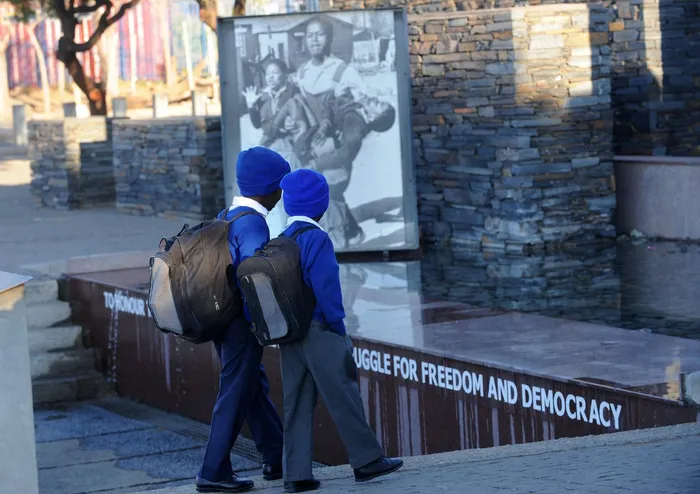
The ripple effects of that day were felt deeply by those in the frame. Antoinette Sithole, only 16 at the time, vividly remembers the atmosphere of that morning, including the singing of “Nkosi Sikelel’ iAfrika,” a song banned by the regime, and the genuine sense of hope.
When the shots rang out, the chaos separated her from her brother. She arrived at the scene only to be told the heartbreaking truth that the boy in the arms of a stranger was dead.
“When I look at that picture, I cannot remove myself from what happened that day… The photo itself did not only change our lives as such, but it was a turning point for all South Africans; it did not matter the colour [of their skin],” said Sithole.
Sithole reflects on the image’s enduring weight and the profound role it played in dismantling the apartheid regime.
“In actual fact, it took me years to realise that the photo was powerful,” Sithole recalls, noting that the true scale of its influence only crystalised as she watched decades of commemorations including the singing, the chanting, and the candlelight vigils held to remember the fallen.
For a world largely insulated from the brutality of life under apartheid, the image served as an undeniable confrontation with reality.
“The picture was shown to the world for them to see how people suffered during the apartheid era,” Sithole says, listing the injustices such as the torture, the torment, and the blatant human rights violations, that the frame laid bare.
“Most of the people could not believe what was really happening; they were shocked and surprised.”
This global shock quickly translated into political and economic pressure and according to Sithole the swift international response was evidence of the photograph’s power to galvanise action.
“I remember that some companies sanctioned South Africa, and the first company to leave was Kodak; others followed suit,” she stated, adding that “We really suffered, but it was for a good cause.”
When asked if the struggle would have unfolded differently had that moment gone unrecorded, Sithole is clear. “I think so. We may be telling stories, but for people to understand better, we need photos to emphasise the reality. Who knows [if] we would still be oppressed.”
She believes that apartheid would probably not have come under the same level of international pressure if the world had never seen that picture.“The photograph made an impact addressing problems in SA and they took action.”
The man who carried Hector, Mbuyisa Makhubu, faced a different, quieter tragedy. Hunted by police who accused him of posing for the camera to shame the country, Makhubu was forced into exile. He never returned.
His sister, Gwendolyn Nontsikelelo, recalls a brother who returned home hurt and confused, forever changed by the burden of trying to save a life that slipped away in his arms. His disappearance left a void that the international fame of the photograph could never fill.
Image: Independent Media
The image’s journey was swift, unstoppable, and by June 17, it was circulating globally, appearing in Time Magazine and across Reuters syndication, according to Thulani Nzima, chairperson of the Sam Nzima Foundation.
He said it dismantled the government’s propaganda machine, proving to the world that the regime was turning its weapons on unarmed schoolchildren. It became a permanent fixture in the movement against Apartheid; even Nelson Mandela kept a copy in his prison cell, a grounding reminder of the stakes.
He noted that the impact of the photograph was unique because it provided the first visceral glimpse of the regime’s true nature.
“The picture exposed the brutality of the Apartheid regime in a manner never told before; it gave brutality and Apartheid a face as depicted by its ruthlessness against Black people, young and old and defenceless,” he explained.
Now, as South Africa marks the 50th anniversary of the uprising, the conversation has shifted. The photo remains a legendary piece of heritage, but its relevance to the youth of 2026 is increasingly complex.
She argues that the post-1994 transition failed to deliver the educational and economic reforms that were the core of the 1976 struggle.
“When we took up the fight against the adoption of Afrikaans as a medium of instruction, we thought we were going to win the fight once democracy came… But things have been moving at a snail’s pace. Look at what is happening to our children. They go to school, but struggle to get jobs. Our children have become demotivated as a result,” she said.
Her message to the youth of today is one of agency as she urges them not to wait for change but to force it, using the same spirit that drove the students of 1976 to the streets.
“What I can say to young people as we commemorate or celebrate 50 years of the Soweto uprising is that they must take their placards to Parliament and other public spaces. They must drive the change they want to see. There is GBV, there are high rates of unemployment, and there are many other challenges, including the drug Nyaope, which affects them. They must do that as a way to honour those who died.”
Today, Sithole said the image still carries the sting of the past, even for generations born into freedom. “It still hurts,” Sithole admits. “And from what is happening today, people don’t believe that life can be so cruel. People died for us to have a better life.”
As the memory of 1976 moves further into the past, Sithole believes that the photograph is not merely a memorial, but a living lesson.
“My concern is that history is important for us not to forget where we are coming from and where we are heading…How can you go forward without knowing your history? It made us who we are—a reflection.”
Her message to the youth is one of continued responsibility. “Never lose hope,” she says, urging them to continue shaping the country responsibly. “It is their future.”
Five decades on, the photograph of Hector Pieterson is more than a historical artifact. It remains a point of reference, a standard against which the current generation is measuring the freedom and dignity of a nation still in the process of becoming.