



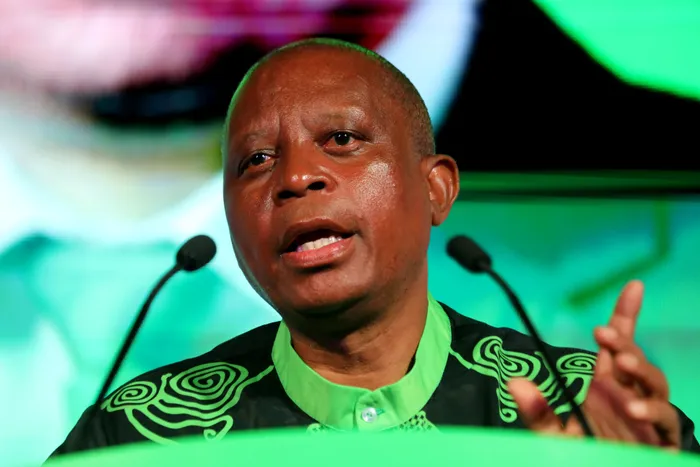
ActionSA leader Herman Mashaba says undocumented foreign nationals left stranded after deportations should be assisted by their home countries, not South Africa.
He said that if his party comes to power, it will deport all undocumented foreign nationals to their home countries.
Mashaba made the remarks in a recent interview with IOL.
His comments come amid growing protests over illegal immigration across South Africa, with some groups calling for undocumented foreign nationals to leave the country.
Hundreds of migrants continue to arrive at the repatriation centre as authorities press ahead with deportations and voluntary repatriations through the Musina Repatriation Centre.
The increase follows the closure of the Durban Repatriation Centre and comes amid growing calls by anti-migrant organisations for undocumented immigrants to leave South Africa.
Some foreign nationals have been deported or have voluntarily returned to countries including Mozambique and Malawi as tensions over illegal immigration continue to rise.
Others have been left stranded without the means to return to their home countries.
Mashaba said that was not South Africa’s responsibility.
“It is not South Africa’s problem. Let it be the problem of those countries. It’s not our problem,” he told IOL.
“South Africa is not a place to harbour criminals because people who came into our country illegally are criminals.
“No one can expect South Africa to take over or allow other countries to outsource their problems to us. So if South Africa dumps them at Musina or anywhere else, it becomes their respective country’s problem.”
Mashaba reiterated that it was not South Africa’s responsibility.
“I want the people of South Africa and the world to know that South Africa is not only dealing with illegal migrants from Africa. We’re dealing with illegal immigrants from as far afield as Pakistan, Bangladesh, India, China and many other countries.”
Mashaba, who has long been outspoken on immigration, said that if his party comes to power, it would deport all undocumented immigrants.
“If South Africans give us the mandate to govern, we are going to make sure that those who are in our country illegally, and those who acquired South African citizenship fraudulently, are dealt with. We will fight to revoke those citizenships and ensure they are returned. We want to see mass deportations.
“It’s the only time that South Africans can get dignity.
“We’re not concerned about critics who want to promote illegality and chaos in South Africa. South Africa is not going to be built on the back of chaos.
“South Africa can only be built when all of us respect the rule of law,” he said.
Speaking to IOL, independent political analyst Goodenough Mashego said Mashaba was campaigning on an issue that fell outside the powers of local government.
“Mashaba, first of all, is going into a local election, and the local government does not have the power to set immigration policy.
“If he goes nationally, he can’t even win nationally, so it’s neither here nor there. Whatever he says does not matter. He’s not going to win. Even if he were to get more votes, he can’t win enough to set that policy.”
Mashego said immigration would likely remain a prominent campaign issue because many voters did not understand the limits of local government authority.
The local government elections will be held on November 4, 2026.
“People will say, ‘If I’m elected, I’m going to do one, two, three,’ but councillors and mayors don’t have the power to do that.”
He said Mashaba appeared to be trying to stay ahead of the political narrative because he believed Patriotic Alliance (PA) leader Gayton McKenzie had successfully mobilised support through his “Abahambe” campaign ahead of previous elections.
“That worked for him, and now everybody’s trying to make it work for them.”
“Even the uMkhonto weSizwe Party seems keen to make it work for them. If you follow what Andile Mngxitama and others are saying, everybody believes immigration is going to work for them.”
Mashego said the strategy might win political support, but parties would ultimately fail to deliver because immigration policy was determined by the national government, not municipalities.
“The power to set immigration policy rests with the national government.
“There is no one political party that will ever win a majority in South Africa. We are done with political parties that win outright majorities. Going forward, it will be governments of national unity, where one party’s narrative is not going to prevail over the others,” Mashego said.
Political analyst Solly Rashilo said immigration had become one of the country’s defining political issues.
“Yes, it has become a major political flashpoint in 2026. Surging anti-migrant protests, the June 30 ‘deadline’, concerns over violence and record deportations of more than 53,000 people reflect deep public anger over unemployment, crime and pressure on public services.”
He said multiple political parties were capitalising on the issue, placing additional pressure on the African National Congress (ANC), which is leading the Government of National Unity (GNU).
“It resonates as a proxy for governance failures but risks accusations of xenophobia.”
Rashilo added that the issue of immigration will remain prominent during the elections.