




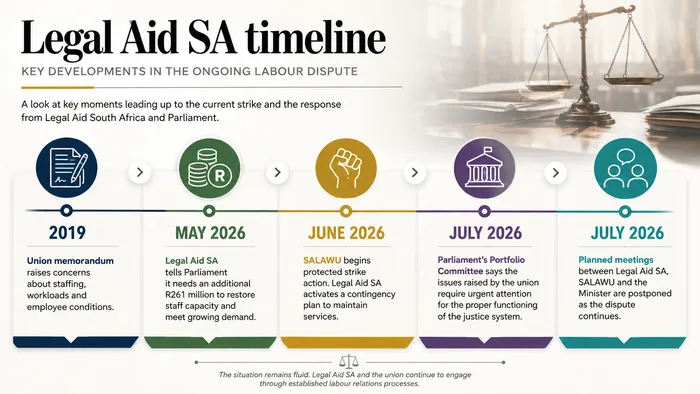
Legal Aid South Africa faces critical staffing shortages and funding pressures, leading to significant delays in the justice system and impacting vulnerable individuals’ access to legal representation.
For some accused people, the absence of a Legal Aid lawyer in court can mean the difference between applying for bail that day and spending another seven days or longer behind bars.
That, according to two sources familiar with conditions inside Legal Aid South Africa, is one of the human costs of practitioner and support staff shortages as the organisation grapples with funding pressures and an unresolved labour dispute.
The first source said that where bail can be dealt with at a first court appearance, an accused person may be able to apply immediately.
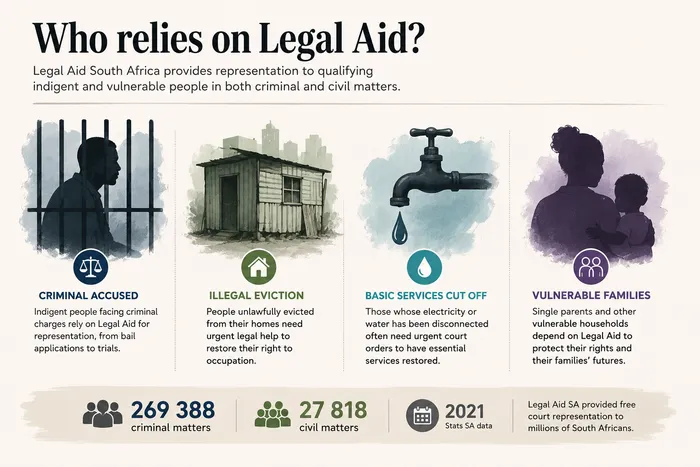
Image: ChatGPT
However, if no Legal Aid practitioner is available, the matter can be postponed for legal representation and bail, with the accused remanded in custody in the meantime – typically for seven days, and often longer.
The number of South Africans who rely on state-funded legal representation is substantial. Statistics South Africa’s latest figures show Legal Aid SA provided free court representation to 269,388 people in criminal matters and 27,818 in civil matters.
Legal Aid SA is mandated to provide legal representation to qualifying indigent and vulnerable South Africans who cannot afford private legal services, making it a critical part of the country’s justice system.
IOL’s insiders explain that the consequences can extend well beyond the courtroom. An accused person could lose income or even their job while in custody. In a single-parent household, the source said, children could be left without their primary caregiver.
Backlogs, delays, postponements
The second source said the effects extended beyond individual cases.
“The biggest impact is on the public. Without enough support staff, the courts cannot function efficiently. Cases are postponed, backlogs increase, victims wait longer for justice, and accused persons remain in custody for extended periods awaiting trial,” the source said.
IOL’s source added that “our members remain committed to serving the public, but the justice system cannot operate effectively without adequate staffing and resources. Ultimately, it is the people of South Africa who pay the price.”
Practitioner shortages can affect every stage of the criminal justice process, said a source. They explained that, where bail applications cannot proceed because no Legal Aid practitioner is available, accused people remain in custody until the matter can be heard.
For matters requiring formal bail applications, shortages can delay hearings because consultations and preparation cannot take place timeously, the insider noted.
Where practitioners are in short supply, criminal trials can be postponed more frequently, leaving accused people who have not been granted bail in prison for extended periods while awaiting trial. “The higher the caseload of practitioners and/or the less practitioners Legal Aid can employ means less court time, less matters being heard and clients suffering due to the delays,” the source said.
Civil matters and rural offices
The effects are not confined to criminal matters.
Capacity constraints can also affect people seeking urgent civil relief, including those who have been illegally evicted or had their electricity or water disconnected. These matters often require urgent court applications to restore occupation or services, said a source.
IOL’s source added that delays in securing legal representation can weaken the argument that the matter is urgent, potentially leaving vulnerable families without immediate relief through no fault of their own.
The source also raised concerns about satellite offices, particularly in rural areas, where clients may travel long distances to seek legal assistance only to find no attorney is available. “In the less densely populated provinces the distance between a satellite office and a local office can be over 75km or, like the Northern Cape, easily over 100km.
“Our clients are already indigent, and they hike or walk to the nearest office, or use public transport so they use their last South African Social Security Agency money to travel to an office only to be told there is no attorney that can go to court for this urgent application.”
No money
Budget constraints have also reduced Legal Aid SA’s ability to refer qualifying matters to private practitioners through its Judicare system. Legal Aid SA has confirmed to Parliament that a R261 million budget reduction has forced difficult staffing decisions.
At the same time, a R813 million reduction over the medium-term expenditure framework led to the discontinuation of the interim retirement extension.
Deputy Minister of Justice Andries Nel warned Parliament that Legal Aid SA’s expanding mandate had not been accompanied by corresponding resources, describing the pressure as “a real danger” and “a real risk that is unfolding.”
What Legal Aid SA says
Legal Aid SA has previously acknowledged that budget constraints are affecting its operations, saying mandatory budget cuts had prevented increases in headcount and employee value proposition benefits, while staff optimisation projects had been initiated to alleviate excessive caseloads. Staff compensation accounts for about 80% of its budget.
However, Legal Aid SA’s own industrial action contingency plan, issued before the strike began, acknowledged that the action had “the potential to disrupt Legal Aid SA’s delivery of services to clients and other stakeholders”.
The plan anticipated that staff resources would be limited during the strike and introduced measures aimed at maximising available capacity – suspending flexible work arrangements and annual leave, revoking previously approved leave, requiring non-striking employees to sign manual attendance registers three times a day, and directing employees participating in the strike to return their case files to managers.
Remains committed
Ahead of the strike, Legal Aid SA said it had activated business continuity measures to minimise disruption and ensure clients continued to receive legal assistance and representation.
Legal Aid SA has since reiterated that it remains committed to ensuring access to justice while engaging with the South African Lawyers and Allied Workers Union (SALAWU) through established labour relations processes.
Parliament has also said it will step in to help resolve the issues, moving to bring management and workers’ representatives together after warning that the issues raised require urgent attention for the proper functioning of the justice system.
“Legal Aid SA welcomes the continued interest of Parliament and other stakeholders in matters affecting access to justice. The organisation remains committed to engaging constructively with all relevant stakeholders on matters impacting its operations, while continuing to fulfil its constitutional mandate of providing legal aid services to qualifying indigent persons,” the entity said.