




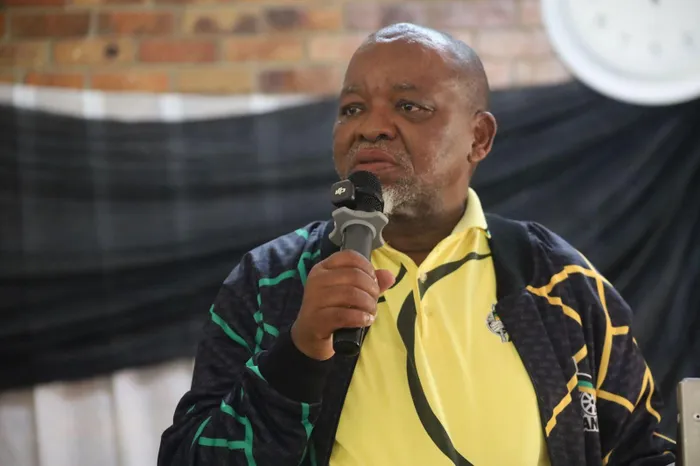
ANC national chairperson Gwede Mantashe says the party must be prepared to serve in opposition where it lacks sufficient support to govern, rather than seek to retain power at all costs as it considers coalition arrangements following its poor performance in the 2026 local government elections.
Speaking on the ANC Connect podcast, Mantashe said the party was developing a coalition framework that included exploring confidence-and-supply arrangements and the possibility of going into opposition.
He said the ANC should not automatically align itself with the DA in the name of stability or choose black-led parties based on racial identity, arguing that coalition decisions should be determined by the circumstances of individual municipalities.
“The ANC must never seek to govern at all costs. Where we are a small party, we must be content to be in the opposition and be an effective opposition, something that is not in our dictionary. It’s a strategy that we must develop,” he said.
Mantashe said the party needed to be selective about its coalition partners rather than adopt a blanket approach to negotiations.
“The two extremes that are cited by people are: either work with the DA, we have stability. I don’t buy that. Or go and work with black parties because of the colour of the skin. I don’t buy that,” he said.
He said the ANC should examine each municipality individually and develop a governance arrangement based on its particular political circumstances.
Mantashe’s comments come after the ANC’s support dropped from approximately 45% to 30% in the local government elections, a decline of 15 percentage points that he acknowledged was catastrophic.
Despite the setback, he rejected suggestions that the party was nearing political collapse, pointing to the number of municipalities in which it remained the largest party.
He said the ANC governed 53 municipalities outright and was expected to form governments in another 129 municipalities where it had emerged as the biggest party without securing an outright majority.
Fragmentation of the vote
Mantashe attributed part of the changing electoral landscape to the fragmentation of the black vote, pointing to the 520 parties that contested the elections, most of which he said were black parties.
He argued that the proliferation of smaller parties weakened the collective voice of black voters while the white vote was consolidating.
However, he acknowledged that the ANC also needed to take responsibility for its declining support and listen more closely to voters.
“Our people are sending a message to us that, listen to us more. And I think if we do that as the ANC, we’ll be a better party,” he said.
He identified the black middle class as one of the constituencies the ANC needed to engage more effectively, arguing that traditional door-to-door campaigning was not sufficient to reach this group.
Instead, he proposed reviving house meetings and sectoral engagements where professionals and other members of the middle class could raise concerns and participate in developing solutions.
Mantashe also said the ANC had failed to communicate the gains of transformation, including opportunities secured through labour struggles and policies that opened previously restricted professions and industries to black people.
Mantashe rules out leadership resignation
Mantashe also dismissed the possibility of the ANC’s current leadership stepping down following the election results, saying leadership changes should be determined through the organisation’s internal structures.
He said the national executive committee (NEC) was the ANC’s decision-making structure between conferences and that its decisions should be respected by members and former leaders.
“If the ANC, for example, says to us that the leadership must go, we’ll go,” he said.
He criticised individuals who publicly called for the leadership to step down instead of raising their concerns within the party’s structures, saying such conduct bordered on ill-discipline.
Mantashe said former leaders had a responsibility to help rebuild the organisation rather than contribute to its destruction.
“Former leaders don’t have the responsibility to destroy the ANC and accelerate the destruction. They must accelerate, they must resist destruction, contribute in the ANC rebuilding itself and reconstituting itself,” he said.
He said rebuilding the ANC would require the organisation to humble itself before voters, improve its communication and develop separate strategies for rural communities and urban areas.
He also called for the ANC Women’s League, Youth League and its relationship with trade unions to be strengthened to reconnect the organisation with different sectors of society.