



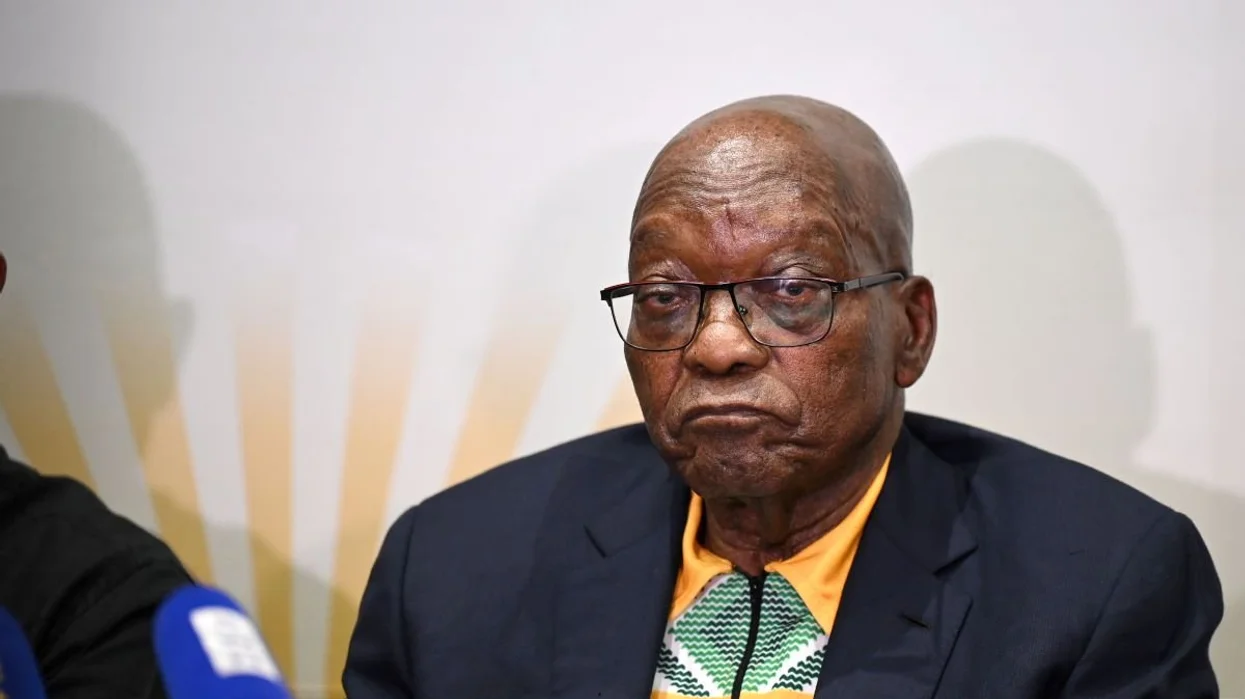
Former President Jacob Zuma is preparing to ask the Presidency to protect his pension from attachment as he seeks to avoid repaying nearly R29 million in taxpayer-funded legal fees.
The Star reported that the JG Zuma Foundation says Zuma will be advised to ask the Presidency for a written undertaking that it will not pursue execution proceedings, including attaching his pension, while it considers a proposed claim against the state.
This follows last week’s Constitutional Court dismissal of Zuma’s application for leave to appeal a ruling that he must repay R28,960,774.34 spent by the state on his personal legal defence in corruption cases.
The apex court dismissed the application with costs, finding that its jurisdiction was not engaged on the merits of the appeal.
However, the foundation has disputed the court’s finding.
Its spokesperson, Mzwanele Manyi, said the courts had declared the state’s decision to fund Zuma’s legal representation unlawful but had not found that Zuma was personally responsible for authorising the expenditure.
Manyi said the arrangement was concluded in 2006 under then-president Thabo Mbeki and continued under subsequent administrations.
“Zuma did not interpret the State Attorney Act, authorise the expenditure or approve the payments. He accepted an undertaking made by the state. The court found the State’s decision unlawful. It made no finding that President Zuma was responsible for that decision,” Manyi said.
He argued that Zuma’s appeal raised a constitutional question under Section 172(1)(b) of the Constitution: whether it would be just and equitable to order an individual to repay the full amount when the state had made the unlawful decision to fund the legal costs.
Manyi criticised the Constitutional Court for dismissing the application without explaining why the question was not constitutional or of public importance.
“This applies with particular force in a matter involving constitutional remedies and substantial public funds,” he said.
Manyi said the foundation would, subject to legal advice, advise Zuma to serve notice of a claim for indemnification on the Presidency, the Minister of Justice and Constitutional Development, and the State Attorney.
The proposed claim would be brought under Section 3 of the Institution of Legal Proceedings against Certain Organs of State Act 40 of 2002.
“The claim would cover any amount President Zuma is compelled to pay,” Manyi said.
The foundation also wants the Presidency to undertake in writing that it will not pursue execution proceedings, including the attachment of Zuma’s pension, until the indemnification claim has been decided.
Manyi further called on the Director-General in the Presidency and National Treasury to establish which officials authorised the expenditure and whether any personal liability arose.
“Where the state makes the unlawful decision, the state must answer for the consequences of its own error. The actual perpetrator must assume full accountability,” he said.
How the legal fees dispute began
The dispute dates back to 2006, when the Presidency approved state-funded legal representation for Zuma following a request from him.
In March 2018, after the National Prosecuting Authority reinstated corruption charges against Zuma, the Presidency said the decision had been taken in accordance with Section 3(1) of the State Attorney Act 56 of 1957.
Then presidential spokesperson Khusela Diko said the decision followed advice from the then chief state law adviser, the director-general of the Department of Justice, the justice minister and the State Attorney.
She said the arrangement was subject to an undertaking by Zuma to refund the legal costs if his defence was unsuccessful.
Although the Presidency said it had been unable to locate a written agreement between the parties, it had copies of undertakings signed by Zuma on August 22, 2006, and September 26, 2008.
The Democratic Alliance subsequently challenged the decision in the High Court in Pretoria, seeking an order declaring that the state was not liable for Zuma’s personal legal costs and that he should repay the money.
In December 2018, the court declared the Presidency’s decision invalid and set it aside.
The court also directed the State Attorney to take all necessary steps, including instituting civil proceedings, to recover the amounts paid towards Zuma’s legal costs.