




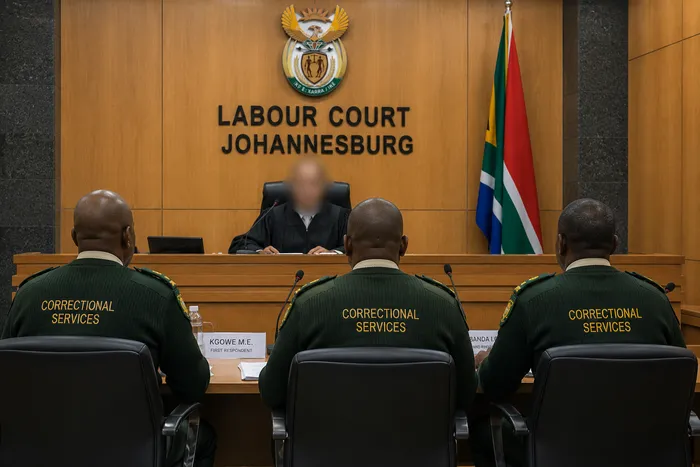
The Labour Court in Johannesburg has overturned a settlement agreement that reinstated three dismissed Department of Correctional Services (DCS) employees with full back pay, ruling that the agreement was unlawfully concluded and ordering that their unfair dismissal disputes return to arbitration for a hearing on the merits.
Acting Judge Snyman ruled in favour of the Department of Correctional Services after it launched an urgent self-review application to challenge its own decision to settle the employees’ dismissal disputes.
The court found that the department had established sufficient grounds to have the settlement agreement and the arbitration award based on it declared invalid.
The case involved employees M.E. Kgowe, A.W. Zwane and I.O. Banda, who had been dismissed after an internal investigation into alleged fraudulent conduct at the Krugersdorp Community Corrections Office.
According to the department, investigators uncovered evidence that the officials had falsified parolee supervision records by recording supervision visits that had never taken place, thereby creating the false impression that parolees had been properly monitored.
Following disciplinary hearings, all three employees were found guilty of misconduct and dismissed in February 2024, with their internal appeals later being rejected.
The employees referred unfair dismissal disputes to the General Public Service Sector Bargaining Council. However, before arbitration could proceed, a senior departmental official sought authority to settle the cases, claiming there was insufficient evidence to defend the dismissals successfully.
A settlement agreement was subsequently concluded in March 2025, providing for the employees’ reinstatement from May 2025, payment of full back pay dating back to their dismissals and the withdrawal of their disputes. The agreement was later made an arbitration award, and the employees received substantial back-pay payments during 2025.
The settlement later attracted the attention of the Departmental Investigation Unit, which questioned how the agreement had been reached. Internal memoranda revealed concerns that the official responsible for recommending the settlement had not consulted investigators or witnesses and had incorrectly asserted that the department lacked evidence to prove the misconduct.
These concerns prompted the department to obtain legal advice, which concluded that the settlement agreement could be vulnerable to review because mandatory internal approval processes, including consultation with the finance division under the department’s delegation framework, had not been followed before the agreement was signed.
Although the employees and their union, the Police and Prisons Civil Rights Union (POPCRU), argued that the department had delayed too long before bringing the review application, the court held that the matter should nonetheless be heard urgently.
Judge Snyman acknowledged shortcomings in the department’s explanation for parts of the delay but found that the case involved the continued exercise of allegedly unlawful public power, ongoing expenditure of public funds and broader considerations of legality and the public interest. The court concluded that these factors justified urgent intervention despite the delays.
The judgment emphasised that organs of state have a constitutional duty to correct unlawful decisions taken by their own officials. Judge Snyman said self-review applications have become increasingly common and stressed that public institutions are obliged to act when they discover irregular or unlawful exercises of public power, particularly where public money is involved.
After examining the evidence, the court concluded that the settlement agreement had been concluded unlawfully because the official who authorised it failed to comply with mandatory delegated authority requirements before entering into the agreement. The judge rejected arguments that the defect could later be corrected through ratification or the parties’ subsequent conduct, holding that compliance with the prescribed approval processes had to exist before the agreement was concluded.
Rather than finally determining the employees’ dismissal dispute, the court exercised its discretion to restore the matter to its proper procedural course. Judge Snyman ordered that the settlement agreement and the arbitration award based on it be set aside and directed that the unfair dismissal disputes be remitted to the bargaining council for a fresh arbitration before a different arbitrator on an expedited basis.
Regarding the money already paid to the employees, the court declined to make an immediate order for repayment, leaving it up to the department to pursue recovery through its own channels or allow the future arbitrator to factor the payments into any potential final relief.