



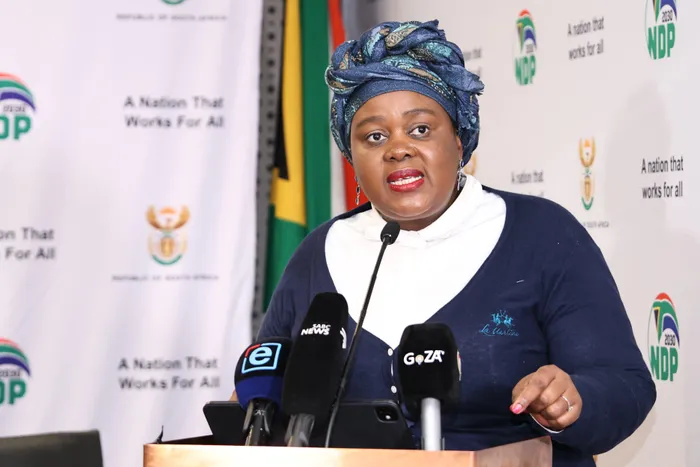
The chairperson of the Inter-Ministerial Committee (IMC) on Migration, Mmamoloko Kubayi, has declared June 30 a normal working day despite planned nationwide protests calling for undocumented migrants to leave South Africa.
The IMC briefed the media on Friday to provide an update on the government’s comprehensive approach to migration management ahead of the planned demonstrations.
The briefing comes ahead of nationwide protests scheduled for Tuesday, targeting undocumented foreign nationals.
In recent weeks, protests have intensified in parts of the Western Cape, KwaZulu-Natal and Gauteng, where groups have targeted undocumented migrants.
Anti-migrant organisation March and March and other civil society groups have called on undocumented foreign nationals to leave South Africa by June 30.
At a media briefing in Midrand on Wednesday, more than 20 anti-migrant organisations and civil society groups involved in the protests pledged that the demonstrations would remain peaceful and would not result in violence, looting or loss of life.
However, March and March leader Jacinta Ngobese-Zuma said her organisation would not accept responsibility if violence erupted during the protests, arguing that maintaining public order is the responsibility of the state.
Kubayi reiterated President Cyril Ramaphosa’s remarks made during his reply to oral questions in the National Council of Provinces (NCOP) on Thursday that enforcing the law is the responsibility of the state.
“Thus, we are ready as a State to protect every person, citizens and foreign nationals, against any form of abuse and intimidation.
“We therefore declare that the 30th of June 2026 as a normal day for the country,” she said.
Kubayi stressed that no unauthorised person is permitted to demand documentation or proof of nationality from anyone.
“Blocking access for anyone to clinics, hospitals, schools or other public services is prohibited and against the law.”
She warned that violence and intimidation directed at either foreign nationals or South African citizens are criminal offences.
“Advocates and perpetrators of racism, sexism, xenophobia, tribalism, hate speech, Afrophobia and any other form of intolerances have no place in our country that is founded on the ideals of Ubuntu and our founding document for our constitutional democracy – our Constitution.”
She also warned that misinformation, incitement to hatred or violence and fake news spread on social media or other media platforms would be prosecuted.
“We reiterate that, while most employers comply with relevant immigration and labour laws, those employers who continue to employ and exploit undocumented migrants will be prosecuted in accordance with the Immigration Act.”
Kubayi said the government had intensified intelligence-led, prosecutorial-guided operations across the country.
She said that, as of June 21, a total of 89 public order and incitement-related incidents had been registered as criminal cases, up from 53 the previous week.
“A total of 164 people have been arrested for offences including incitement of violence, contravention of the Regulation of Gatherings Act, and other related transgressions.”
She said 36 of those cases are already before the courts, while 40 remain under active investigation.
Kubayi said multidisciplinary enforcement operations led by the deputy ministers of Home Affairs, Police, and Employment and Labour have continued in several provinces.
“A recent operation conducted in Tshwane resulted in 35 arrests, including two employers charged with employing undocumented foreign nationals.”
The government says more than 15,000 Malawian nationals have been processed for deportation and repatriation, while urging South Africans to allow law enforcement to deal with illegal immigration ahead of planned nationwide protests.
The government says more than 15,000 Malawian nationals have been processed for deportation and repatriation, while urging South Africans to allow law enforcement to deal with illegal immigration ahead of planned nationwide protests.
She added that SAPS, through its weekly Operation Shanela conducted across various provinces, arrested 5,056 people for contravening immigration laws during the week of June 15 alone.
Kubayi also condemned recent anti-immigration protests that were accompanied by looting in the Free State on June 16 and June 18.
“SAPS has opened cases and arrests have followed.
“We reiterate that vigilantism, looting and the targeting of individuals based on nationality are criminal acts that will be met with the full force of the law.”
She confirmed that 15,162 Malawian nationals had been processed for deportation and repatriation, while others were still undergoing verification at temporary repatriation centres across the country.
Acting Police Minister Professor Firoz Cachalia previously announced that R600 million, ordinarily allocated to police stations and community policing, would be redirected towards security operations ahead of the planned protests.
Kubayi said government had made substantial progress in deporting and repatriating undocumented foreign nationals.
She said several countries had offered to facilitate the voluntary repatriation of their nationals following deportation procedures at the Lindela Repatriation Centre.
Among those countries are Malawi, Ghana, Nigeria, Mozambique and Zimbabwe, while Kenya and the Democratic Republic of Congo are the latest to request voluntary repatriation.
“As you are aware, the repatriation process is voluntary and requesting countries bear the primary responsibility for transportation cost and management of logistics in this regard.
“Under normal circumstances, the responsibility of the host country only involves verification and issuance of orders to leave,” she said.
Kubayi said financial and humanitarian assistance is provided in exceptional circumstances on a case-by-case basis.
“As you might have observed from the scenes in Sherwood and Che Guevara, Durban Drive-in, eMsunduzi areas in KwaZulu-Natal, the Malawian nationals’ situation had become untenable in terms of numbers and the humanitarian emergency that has arisen henceforth.”
She said that, as of the close of business on June 25, a total of 15,162 Malawian nationals had been processed for deportation and repatriation.
“Given the gravity of this situation and the need to expedite the deportation and repatriation of these foreign nationals, we have taken a decision to extend the jurisdiction of the Musina Refugee Reception Office in the Limpopo Province to also conduct verifications,” she said.
Kubayi said all logistical arrangements for repatriation in Musina had been activated.
She said government would work with stakeholders including the Office of the United Nations High Commissioner for Refugees (UNHCR), the International Organization for Migration (IOM), the Red Cross, Future Families, the Musina Legal Advice Office, the Outreach Foundation, Save the Children and the Consul General of Malawi to facilitate the process.
Kubayi said the IMC Technical Committee on Migration had identified a site outside Musina in Limpopo for a Temporary Repatriation Processing Centre.
“The repatriation centre currently utilised in eThekwini will be closed and all Malawian nationals will be transferred once all logistics are finalised.”
She said the proposed facility would enable faster processing and verification of undocumented foreign nationals, facilitate more efficient movement through the Beitbridge Port of Entry, and reduce pressure on the Lindela Repatriation Centre.
“This intervention is intended to support timely deportation, improved compliance with legal timeframes, and enhanced operational resilience under current surge conditions,” she said.