



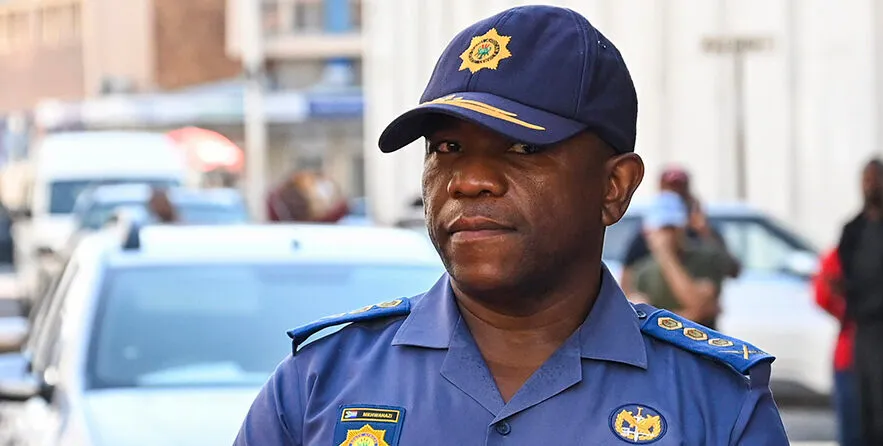
The government has rubbished allegations that KwaZulu-Natal provincial police commissioner Lt-Gen Nhlanhla Mkhwanazi is protecting Zulu-speaking people and criminals amid protests over asylum applications.
The government was responding to claims that police in the province, under Mkhwanazi’s leadership, were giving preferential treatment to Zulu-speaking criminals in Durban during recent protests.
The allegations come amid violent demonstrations in KZN and Gauteng last week, during which several cars and houses were torched and shops looted.
The unrest followed protests calling for refugee centres to stop processing asylum applications.
The demonstrators oppose a July Constitutional Court ruling that removed procedural barriers to seeking asylum, including for people who entered South Africa irregularly, lacked asylum transit visas or missed reporting deadlines.
Thirty people had been arrested since Thursday in connection with public violence and alleged attempts to destabilise communities.
Of those arrested, 25 were in KwaZulu-Natal and five in Gauteng.
The offences included public violence, illegal gatherings, obstruction and resisting arrest.
Speaking at an Inter-Ministerial Committee (IMC) briefing in Pretoria on Sunday, acting police commissioner Professor Firoz Cachalia dismissed the allegations of preferential treatment.
“I don’t want to belabour this point. There’s absolutely no truth to that insinuation that the police in KwaZulu-Natal, if there’s any suggestion of favouritism. They did a very important job. They did their work,” Cachalia said.
“They brought restored stability to the province. And it’s all quiet at the moment. So that’s because the police are present.”
He said police had deployed the necessary resources and were taking appropriate action.
Cachalia recently visited KZN with premier Thami Ntuli and Mkhwanazi to assess public order in Durban’s central business district following the protests.
They also assessed the damage caused by the unrest.
“Premier Ntuli and I made a joint statement condemning acts of lawlessness and arson. So I have no doubt that the premier is committed, as I am, and the members of the IMC, to ensuring stability in KwaZulu-Natal and throughout the country,” he said.
Cachalia said Ntuli had a responsibility to ensure investment in the province and had no interest in encouraging violence.
He also referred to an incident in the province in which three Ethiopian nationals were arrested after allegedly discharging firearms.
He said they have since appeared in court.
Cachalia said foreign nationals, particularly those in the country illegally, had a responsibility to obey the law and refrain from taking matters into their own hands.
He also warned them against confronting protesters who oppose illegal immigration.
“When you do that, you can only worsen your own situation,” he said.
Cachalia condemned the firearms incident, questioning why the three men were armed and had discharged their weapons.
“There can’t be fiefdoms in South Africa that are, in effect, occupied by groups confronting South Africans,” he said.
He reiterated that police would take the necessary action in Durban and elsewhere, including Kroonstad, in the Free State and said further updates would be provided when available.
Meanwhile, Minister in the Presidency Khumbudzo Ntshavheni also rejected allegations against Mkhwanazi, saying he was no longer serving in his substantive position as KwaZulu-Natal provincial police commissioner.
She said Mkhwanazi was serving in an acting capacity as a lieutenant general responsible for organised crime nationally, while KwaZulu-Natal had an acting provincial commissioner.
“So let’s not cast aspersions,” Ntshavheni said.
“If the allegation is that there is protection of criminals, we need to indicate that, from the National Joint Intelligence Operations, commonly known as Njoint, the arrests are majority for criminal activities by the people in KZN,” she said.
Ntshavheni said the government would not comment further on the cases before the suspects appeared in court.
Police would provide details of the charges and other intelligence operations at the appropriate time, she said.
She added that authorities were investigating allegations about funding and financial flows linked to activities that may have used the immigration issue and the Constitutional Court judgment to advance other agendas.
Ntshavheni also addressed concerns about directives issued by the Department of Home Affairs without consultation with the IMC.
She said the committee had not been caught off guard by the directives but had not been consulted by the department.
The IMC has since decided that no immigration directives, whether operational or otherwise, should be issued without full consultation with the committee, as such decisions have implications for other departments and national security.
“Those directives created a national security challenge for us, which we are also responding to,” she said.
Ntshavheni said the government would provide further details about the national security concerns in submissions to a panel of High Court judges established by Gauteng Deputy Judge President Ledwaba.
The IMC has also announced that it will approach the courts for a supervisory order to oversee the implementation of the ruling allowing undocumented immigrants to apply for asylum in South Africa, regardless of how they entered the country.