




A businessman who lost R10 million after paying it into an attorney’s trust account has lost another attempt to recover the money from the Legal Practitioners’ Fidelity Fund, more than a decade after first lodging his claim.
The Supreme Court of Appeal (SCA) has overturned a High Court ruling that effectively gave Rodney Love another chance to pursue the R10 million, finding the lower court had contradicted an earlier SCA decision involving the same money and the same theft.
Love paid R10 million into the trust account of Turnbull and Associates Incorporated in April 2011 for the proposed purchase of shares in Sword Fern Trading. “The sale did not materialise. The R10 million was stolen,” the judgment recorded.
Love also lent nearly R4.3 million to Sword Fern Trading in a transaction facilitated by Alberto Pavoncelli.
By August 2011, Love had become concerned about the share deal and asked for his money back. When it was not returned, he applied for the liquidation of Sword Fern Trading and sued Turnbull for repayment of the R10 million.
In May 2012, Pavoncelli gave Love a written undertaking to repay both the loan and the R10 million. Love later stated in an affidavit that Pavoncelli had given the undertaking because he had personally misappropriated the money.
Pavoncelli did not pay. Sword Fern Trading was placed into final liquidation and Love obtained judgments for repayment, but the sheriff found no property that could be attached to settle the debt.
Love then turned to what was then the Attorneys Fidelity Fund, lodging a R10 million claim in October 2013. The Fund rejected it in 2014 because claims had to be lodged within three months of a person becoming aware, or reasonably being expected to become aware, of the theft.
Love maintained he only became aware of the theft on September 2, 2013, after obtaining copies of Turnbull’s business bank statements.
The dispute has since spent years moving through the courts. In 2017, the High Court found Love had notified the Fund within the required period. A full bench upheld that decision in 2019.
But the SCA overturned those findings in 2021, ruling that Love knew by 28 November 2012 at the latest that the R10 million had been misappropriated and did not need to wait until September 2013 for Turnbull’s business account statements.
Love’s claim had therefore been lodged too late. He approached the Constitutional Court, which declined to hear the appeal in February 2022.
Back to court
However, Love had also launched separate review proceedings against the Fund years earlier. Those proceedings eventually reached the High Court in 2023, with Love arguing that the Fund should have exercised its discretion to extend the three-month deadline.
The High Court agreed and extended the deadline to October 7, 2013, effectively bringing Love’s claim back within time. But in doing so, it found that Love had not known his money had been stolen until September 2013.
That was the problem. The SCA said it had already decided in 2021 that Love knew by November 2012 at the latest that the money had been misappropriated.
“The findings of the SCA and the High Court are directly contradictory factual findings concerning the same claimant, the same R10 million, the same theft and the same historical events,” Judge of Appeal Ashton Schippers said.
The High Court could not revisit that finding simply by considering the case through a different legal route. Schippers said a lower court was bound by the decisions of a higher court, with precedent necessary to ensure certainty and consistency in the law.
The SCA found the High Court had no power to effectively reverse its earlier finding and described its order as an “unlawful exercise of judicial power”.
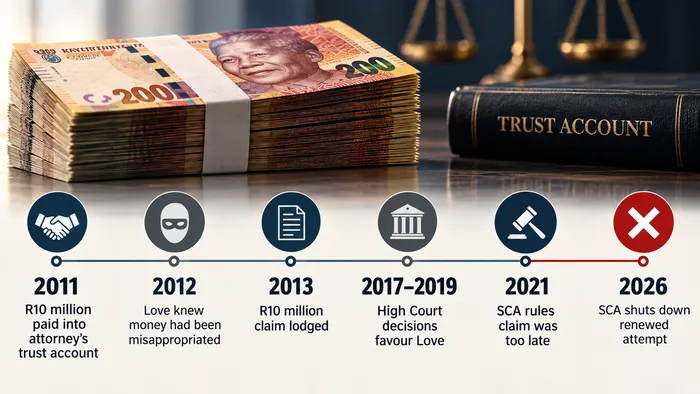
Image: ChatGPT
One dispute, one shot
There was another problem with Love’s attempt.
The SCA found he had effectively split the same R10 million dispute into separate pieces of litigation, first arguing that his claim had been submitted on time and later pursuing an extension of the deadline.
Love already knew when he launched his original action that the Fund disputed whether his claim was on time and that he could alternatively ask for an extension.
The SCA said both arguments should have been pursued together.
“What Love could not do, was to claim a different remedy in successive proceedings, relating to a single cause of action – whether the Fund was liable for repayment of the R10 million,” Schippers said.
The SCA upheld the Fidelity Fund’s appeal and set aside the High Court order extending Love’s deadline. His application was dismissed and he was ordered to pay the Fund’s costs, including the costs of two counsel used in the appeal.