




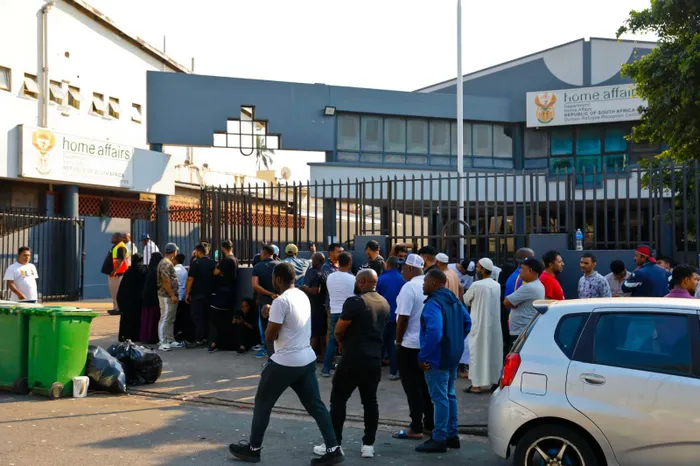
The Department of Home Affairs has withdrawn a controversial directive governing the intake of asylum seeker applications after refugee reception offices were overwhelmed within days of its implementation, raising serious concerns about the safety of officials and public order.
The department confirmed on Friday, October 9, that its Director-General had withdrawn the directive issued on September 28, following a Constitutional Court judgment delivered on July 7 in the Scalabrini of Cape Town matter.
The withdrawal of the directive does not overturn or suspend the Constitutional Court’s ruling, which remains binding on the department.
The department said the directive, which had been circulated to all Refugee Reception Offices (RROs), was intended to facilitate compliance with the court’s ruling but resulted in operational challenges that had not been anticipated.
“However, the attempt to practically implement the judgement immediately led to serious consequences that could not have been foreseen in the Court order,” the department said.
These included refugee reception offices being overwhelmed, threats to the safety of Home Affairs officials, and growing concerns about public safety and order.
Refugee offices overwhelmed within days
According to the department, the implementation of the directive placed immediate pressure on refugee reception facilities, creating operational and security challenges.
The department said the situation deteriorated within days of the directive being issued, prompting the decision to withdraw it.
“This includes, amongst others, the fact that RRO operations were overwhelmed within a matter of days since the directive was issued, Home Affairs officials were placed at risk, and that serious threats to public safety and order had emerged.”
The withdrawal represents a significant reversal in the department’s approach to implementing the Constitutional Court ruling.
Home Affairs rejects claims of political interference
The department has also strongly rejected allegations that the directive was politically motivated, insisting that it was an administrative decision taken without the involvement of the Minister of Home Affairs or other political office-bearers.
It said the Director-General’s office had issued the instruction solely to give operational effect to the Constitutional Court judgment.
“The directive was originally issued to all Refugee Reception Offices (ROs) as a purely operational attempt to support the implementation of the Court’s order without reference to, or the knowledge of, the Minister of Home Affairs or any other political office-bearer.”
The department maintained that suggestions of political interference were unfounded, particularly because it had opposed the Constitutional Court case that led to the ruling.
“Claims that it was a politically-motivated decision are therefore categorically untrue, as the directive emanated from a Constitutional Court case that the Department had opposed.”
The clarification comes amid controversy surrounding the implementation of the judgment and the department’s handling of asylum application procedures.
Department to develop new plan to comply with court ruling
Despite withdrawing the directive, Home Affairs stressed that it remains legally obligated to comply with the Constitutional Court judgment.
In July 2026, the Constitutional Court upheld an earlier Western Cape High Court ruling declaring parts of the Refugees Act unconstitutional and invalid.
The judgment strengthened procedural protections for asylum seekers by making clear that administrative requirements cannot automatically prevent a person from accessing the asylum system.
The department said it would now reassess how the ruling should be implemented, taking into account the operational difficulties and security concerns that emerged.
“With these new facts now at hand, the Department will embark on a fresh process to determine the most appropriate operational approach to ensure compliance with the Constitutional Court’s order.”
The department further reaffirmed its commitment to respecting the judiciary and upholding the rule of law.
It said it remained committed to finding an operationally sustainable method of implementing the judgment without compromising the functioning of refugee reception offices.
The department maintains that its next approach will seek to ensure compliance with the court order while addressing the problems experienced during the initial implementation.