



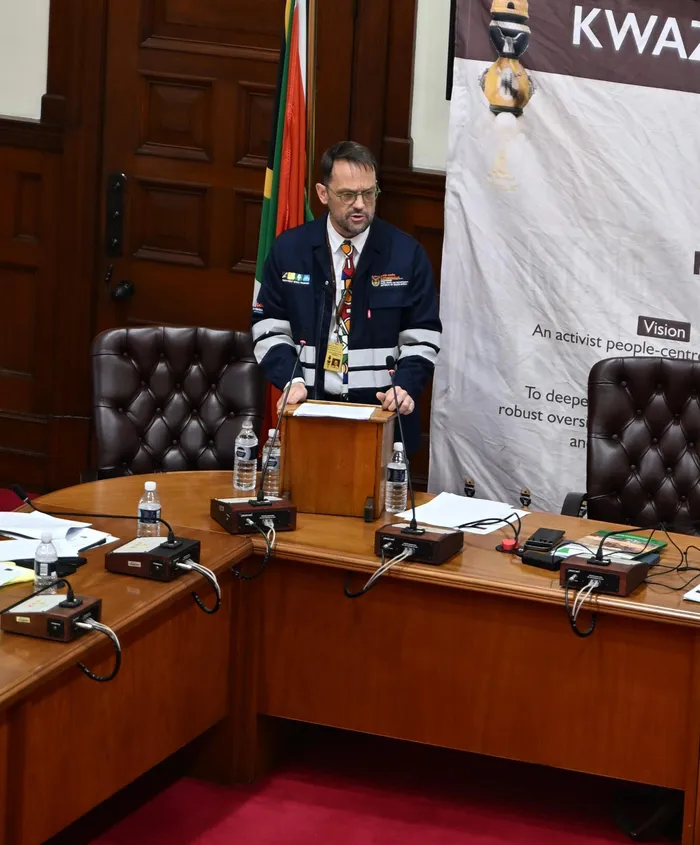
KwaZulu-Natal Department of Public Works and Infrastructure (DPWI) MEC Martin Meyer is leading a push to address a substantial, long-standing rates debt that stands at nearly R2 billion.
Tabling the DPWI’s 2026/27 budget on Friday, Meyer said: “Each year this department services a rates bill that is just under R2bn (R1.9bn) for its properties located across 54 municipalities in KZN, yet our budget allocation is around R800 million per annum.”
Meyer said the department aims to resolve its rates debt through various measures, including the sale of property assets. Having already offloaded 81 properties and land parcels, the department is now targeting the disposal of 10 hectares (including two structures and one vacant plot) -additionally, 11 land allocations to various municipalities, 10 to non-profits, and the private sector for socioeconomic purposes, and five unutilised buildings for disposal.
He announced a R1.8bn allocation for a programme that facilitates integrated property management and accommodation services, encompassing the full property lifecycle, from acquisition and maintenance to disposal, and asset valuation, Fixed Asset Register maintenance, and property rate payments.
“In addition, we are collaborating with KZN Treasury to establish an agreement that allocates a percentage of the sale of unwanted assets to cover our rates bill,” Meyer said.
He said the department’s strategy includes tailored repayment plans per municipality; having the direct value of an asset sold to municipalities go toward writing off that exact amount owed in rates; engaging the South African Local Government Association (Salga) to mediate discussions with municipalities; and pushing to have schools exempt from paying rates.
“It has become unfortunate that, despite our proactive efforts, some municipalities have ignored our efforts to collaborate. In some cases, these are the same municipalities that were all too happy to charge us commercial rates, charge as much as 40% more, and charging rural and lower-quintile schools the same rates as schools in urban and affluent areas,” Meyer explained.
Public Works committee chairperson Petros Msimango said the committee noted that programme carries a large share of the department budget.
“The committee further noted that the budget remains under significant pressure due to the escalating property rates,” Msimango said.
He said committee members raised concerns about increasing property rates and impact of municipality obligations on department sustainability.
The MKP’s Bongumusa Mkhize said the committee noted the department is operating under severe pressure because of escalating municipal property rates.
“You ask yourself… the very same DA that was given to be in charge of this money has not given this department the money it owes for the rates,” Mkhize said.
Satishrai Bhanprakash, from the IFP said the department continues to face significant financial pressures arising from rising municipal property rates, increasing maintenance cost, and outstanding obligations.
Mafika Sangweni, from the ANC said rising municipal property rates, delayed payment of contractors, pressure on infrastructure budget, weakness in provincial property register, and the need for accelerated stalled infrastructure projects determine whether the government becomes an enabler of development or an obstacle to development.
Responding, Meyer said: “The payment of rates remained a single biggest challenge that we face, as this department not paying its rates affects service delivery in municipalities… But in the budget speech, I’ve laid out our plan, and we are dealing with this matter.”