



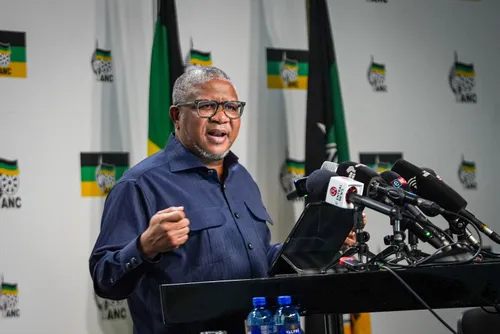
ANC secretary-general Fikile Mbalula has failed to secure a final interdict against ANC NEC member Nkosazana Dlamini-Zuma over her allegations that he distributed money to delegates to influence the outcome of the party’s 2022 leadership elections.
The Johannesburg High Court has ordered oral evidence in the defamation case, with Mbalula and Dlamini-Zuma required to make themselves available for cross-examination.
Acting Judge Henno Viljoen made the order on Friday, finding that the central factual dispute could not be resolved on the affidavits before him.
Dlamini-Zuma made the allegations during an African Renaissance Podcast interview, claiming Mbalula was distributing money to delegates at a clinic during the ANC’s 55th National Conference at Nasrec.
She alleged that the money was used to secure Mbalula’s election as secretary-general and help secure Cyril Ramaphosa’s re-election as ANC president. Mbalula has denied the claims.
He approached the court seeking declarations that the allegations were false, defamatory and unlawful, and wants Dlamini-Zuma ordered to retract the statements and apologise, barred from repeating them and held liable for damages.
Dlamini-Zuma opposed the application and maintained that her allegations were true and in the public interest.
The question before the court
The court has confined the oral hearing to the central allegation in the dispute.
“Oral evidence is to be heard to determine whether at or in connection with the 55th National Conference of the African National Congress held at Nasrec, Johannesburg, from 16 to 20 December 2022, the applicant distributed money to delegates for the purpose of influencing the outcome of the elections held at that conference,” Viljoen said.
If the answer favours Mbalula, the court will then consider the harm to his reputation and Dlamini-Zuma’s conduct since the publication, insofar as those issues relate to whether a retraction and apology should be ordered.
The judgment does not determine whether Mbalula distributed money to delegates or whether Dlamini-Zuma’s allegation was true.
Instead, Viljoen found that the opposing versions raised a factual dispute that required oral evidence.
“The affidavits disclose a real, genuine and bona fide dispute of fact upon a material issue, which cannot be satisfactorily determined without the aid of oral evidence,” he said.
Why Dlamini-Zuma’s version will be tested
Dlamini-Zuma relied on her own evidence and an affidavit from ANC member Mandla Themba Sibiya, who said he received money during the 2022 conference.
Viljoen identified shortcomings in her version, including uncertainty about how she came to know some of the details, as well as a lack of particulars in Sibiya’s affidavit.
But the judge found those weaknesses did not make the evidence so implausible that it could be rejected without hearing from witnesses.
The judge said Sibiya was an identifiable witness whose evidence could be tested through cross-examination.
“This is not a case in which the issues are too undefined and the witnesses too unascertainable for a simple hearing of oral evidence.”
The court therefore directed that oral evidence be heard rather than dismissing the application or referring the entire matter to a full trial.
The hearing has been limited to the central allegation. Mbalula, Dlamini-Zuma and Sibiya are the witnesses currently identified, while any additional witness will require the court’s permission.
Mbalula’s damages claim
Viljoen refused Mbalula’s damages claim in the application, but said this did not prevent him from bringing a separate damages action.
His remaining relief, including the interdict and retraction or apology, stands over pending the outcome of the oral evidence.
The judge said the matter should be resolved as quickly as possible.
“A speedy determination is desirable. Mbalula says that the allegation continues to injure him daily; Dlamini-Zuma says that she stands by what she said and is willing to have it ventilated in court,” Viljoen said.
The court reserved the issue of costs.
“Costs should stand over. The question of who has been substantially successful cannot be answered until the issues referred to oral evidence have been decided,” Viljoen said.