



FREE SA launches a campaign for a constitutional cap on South Africa’s Cabinet size, arguing that the current structure is costly and inefficient.
The proposal aims to streamline governance and reduce taxpayer burden amid growing concerns over political patronage.
Under the current provisions, the President may appoint any number of ministers from members of the National Assembly.
Free SA believes this unlimited discretion has contributed to the growth of one of the world’s largest and most expensive executive structures.
The organisation is proposing an amendment that would cap the number of Cabinet ministers at no more than twenty.
According to Free SA, South Africa’s transition into an era of coalition politics makes constitutional safeguards even more important.
It maintains that larger cabinets increase public expenditure through ministerial salaries, support staff, official residences, security arrangements, vehicles and administrative structures, while often creating overlapping mandates that weaken accountability.
Free SA:
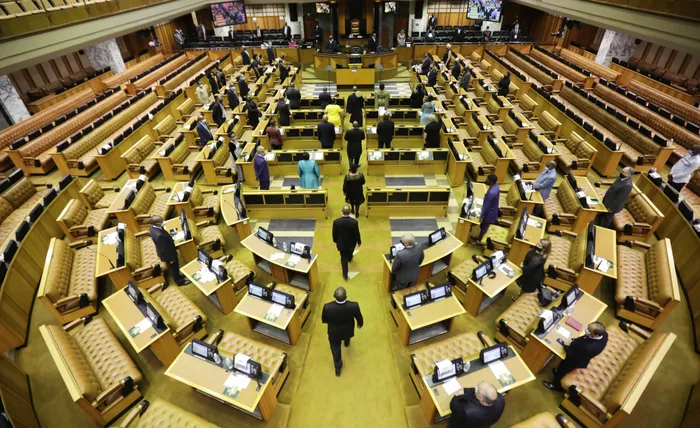
The debate comes amid growing scrutiny of the Government of National Unity (GNU) executive, which currently consists of 34 ministers and 43 deputy ministers, bringing the total executive complement to 77 members.
Paul Maritz, director at Free SA, believes the executive has become excessively large and costly.
“Our proposal is based on creating a lean but functional executive, and 20 should be seen as a target,” said Maritz.
“We have previously argued that it would be possible to create an entire executive with just 26 members in total: the President, Deputy President, 12 ministers and 12 deputy ministers. We understand that such a cut could create instability, and therefore propose 20, which would provide more than enough breathing space for a sitting president.”
He added that the objective is to ensure that every ministry serves a clear purpose.
“The objective is to ensure that every ministry has a clear and necessary function while forcing consolidation of overlapping portfolios. The number is intended to strike a balance between effective governance and fiscal discipline.”
Maritz was particularly critical of the size and cost of the current executive.
“South Africa has one of the most oversized and costly cabinets in the world. The current GNU executive comprises a staggering 77 members – 34 ministers and 43 deputy ministers – who collectively cost taxpayer’s more than R1 billion per year in salaries, benefits, and VIP protection. This is a structure that prioritises quantity over quality, patronage over efficiency, and bureaucracy over effectiveness.”
Free SA argues that executive salaries alone demonstrate the extent of government spending on political office-bearers.
“Each minister earns nearly R2.7 million annually, while their deputies pocket R2.2 million,” Maritz said.
He contrasted these salaries with the realities facing ordinary South Africans.
“While these amounts are high to start with, they are only really understood once they are compared to the socio-economic realities of the average South African. The minimum wage in South Africa currently stands at around R4 500 per month, meaning that a single cabinet minister earns more in a year than a minimum-wage worker would in over 50 years.”
Maritz argued that this gap highlights a disconnect between political leadership and the population.
“This salary gap is not just an abstraction, it reflects the very real disconnect between political elites and the ordinary South African struggling to make ends meet in an economy battered by load-shedding, high unemployment, and stagnant growth.”
According to Free SA, reducing the Cabinet to 20 ministers and 20 deputy ministers would save approximately R91 million annually in salaries alone. The organisation argues that the real savings would come from reducing duplicated departments, support staff, office accommodation, travel budgets, communications teams and security arrangements.
“Ministerial salaries represent only a small fraction of the true cost of a bloated executive. The larger savings come from reducing duplicated departments, office accommodation, support staff, travel budgets, VIP protection, communications teams and other administrative overheads that accompany each ministry.”
A key pillar of Free SA’s campaign is the comparison between South Africa’s executive and those of larger economies.
“The sheer scale of South Africa’s cabinet is difficult to justify. When compared to other global economies, particularly BRICS partners, our executive is an outlier in terms of both size and cost.”
He pointed to examples from around the world.
“Brazil, a nation with over 214 million people, gets by with 37 ministers. India, with a population of over 1.4 billion, has just 30. Even China, the world’s second-largest economy and a nation of 1.4 billion people, operates with a more modest 37 ministers. The United States, with a GDP almost 60 times the size of South Africa’s, has a cabinet of just 24.”
Free SA also noted that Germany, with a population of approximately 84 million people, operated with only 16 federal ministers.
Critics of a constitutional cap often argue that government responsibilities expand over time, requiring new portfolios and ministries.
Maritz rejected that argument.
“The purpose of a cap is to encourage adaptation rather than expansion. New responsibilities do not necessarily require new ministries. Functions can be reorganised, merged into existing portfolios, delegated to provinces, or administered through agencies and departments.”
According to Free SA, a cap would force the government to pursue efficiency rather than creating new political offices.
“A cap forces the government to prioritise efficiency instead of creating additional political offices whenever new challenges emerge.”
The organisation has previously proposed a significant restructuring of government, including devolving functions such as basic education, health, policing and labour to provinces; eliminating several ministries entirely; and merging overlapping departments.
Among the proposed mergers are Electricity and Energy, Water and Sanitation, Transport and Land Reform into Public Works and Infrastructure, and Correctional Services into Justice.
“We propose one deputy per minister.”
For Free SA, the issue is ultimately about restoring public confidence in government.
“The proposal aims to improve government performance in three ways. First, it reduces expenditure on political office-bearers and administrative overheads. Second, it creates clearer accountability by reducing overlapping responsibilities. Third, it seeks to improve policy implementation by reducing bureaucracy and streamlining decision-making.
“The broader objective is a state that spends more resources on service delivery and less on maintaining political patronage structures. Free SA’s position is that ordinary South Africans benefit when the government is leaner, more accountable and more efficient,” said Maritz.