



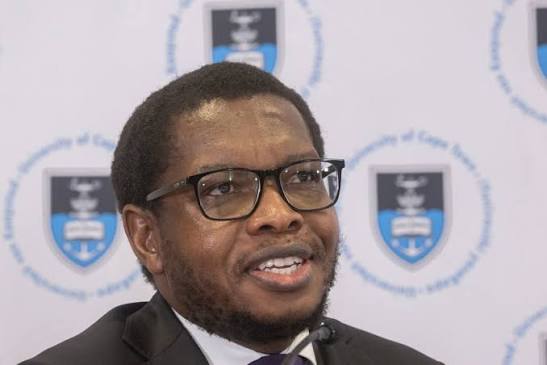
The University of Cape Town Council says it acted independently and in accordance with due process after Vice-Chancellor Professor Mosa Moshabela challenged its handling of complaints concerning his conduct in the Western Cape High Court.
According to reports, UCT’s Ombud had recorded 39 approaches concerning Moshabela by December 2025.
These allegedly included complaints of sexual harassment and discrimination
Reports say an investigation into 34 complaints resulted in no disciplinary action, although the Council raised unspecified behavioural concerns and directed Moshabela to undergo executive coaching.
According to reports, a separate investigation is examining a November 2025 incident in which a UCT security officer entered a female academic’s residence without permission, allegedly on Moshabela’s instruction to check on her wellbeing.
Moshabela is challenging the Council’s handling of both matters.
The developments have drawn comparisons with the tenure of his predecessor, Professor Mamokgethi Phakeng, who also faced numerous complaints and an independent investigation into governance at UCT.
Phakeng’s tenure from 2018 to 2023 ended amid intense institutional tensions and a critical independent panel report
Image: Instagram
Meanwhile, Norman Arendse SC, chair of the UCT Council, said the legal proceedings instituted by the vice-chancellor had understandably generated interest and concern within the university community and beyond.
“UCT is an institution founded on principles of integrity, academic freedom, fairness, accountability and respect for the dignity and rights of all who form part of our community.”
He said the Council has a responsibility to safeguard those principles, as well as the reputation and institutional integrity of UCT.
“Ordinarily, Council would not comment publicly on confidential employment-related matters or on matters which are the subject of pending litigation.”
However, he said certain public assertions and characterisations risk creating an incomplete impression of the circumstances in which the Council was required to discharge its governance responsibilities.
“Without entering into the merits of the pending litigation or compromising the confidentiality owed to any person, I therefore consider it appropriate to provide limited institutional context.”
Arendse said the issues would be addressed through the appropriate processes.
He said the Office of the Ombud is independent and operates separately from the Council.
“While the Ombud accounts to Council annually and, for administrative purposes, reports to the Chair of Council or a Council member designated by the Chair, the independence and confidentiality of that office are fundamental to its proper functioning.”
“UCT staff and students must be able to approach the Ombud in confidence.
“The details of concerns raised with the Ombud, and the identities of those who approach the office, are therefore not ordinarily disclosed to the Chair or Council.”
“This confidentiality serves an important institutional purpose,” he said.
Arendse said it protects those who seek assistance from the Ombud, those about whom concerns may be raised, and the integrity of the university’s processes.
“When concerns relating to the VC required the attention of Council, the Ombud alerted me, in my capacity as Chair of Council, to the existence and seriousness of those concerns, without compromising the confidentiality attaching to them.”
He said he sought independent legal advice and thereafter placed the matter before Council and informed Moshabela.
“The process that followed was undertaken on independent legal advice and was designed to ensure independence, appropriate confidentiality and fairness to all persons affected.”
He said the events of recent months involved difficult and sensitive issues.
“They concern individuals, but they also concern something larger: the ability of the university’s governance structures to discharge their responsibilities independently, fairly and without fear or favour.”
“Council’s responsibility is neither to shield any individual office-bearer from legitimate scrutiny nor to assume wrongdoing merely because an allegation has been made.”
Its responsibility, he said, is to act in the best interests of the university.
“That requires Council to respond appropriately when serious concerns are brought to its attention, while ensuring fairness, appropriate confidentiality and respect for the rights and dignity of every person affected.”
“The fact that Council acts when serious concerns are brought to its attention should never be understood as Council having predetermined the truth of those concerns.”
He said the Council would not properly discharge its governance responsibilities if it simply ignored serious matters because they were difficult or sensitive.
“The VC is entitled to fairness, dignity and due process. Those who approach the Ombud are equally entitled to the protection that legitimately attaches to that process. These principles are not mutually exclusive.”
“The reputation and integrity of UCT are best protected by ensuring that difficult matters are addressed through independent, principled and procedurally fair institutional processes, rather than through public debate.”
He said that in addressing these matters, the Council sought independent legal advice and used independent external professionals to safeguard the independence, fairness and integrity of the process.
“UCT’s reputation has been built over generations and depends upon the integrity of its academic, administrative and governance institutions. Council will continue to discharge its responsibilities in a manner that protects that legacy.”
Arendse added that as legal proceedings are now pending, the Council would exercise appropriate restraint in its public communications.
“It would not be appropriate for Council to litigate these matters through public statements or to disclose confidential information in response to public commentary.”
The Council has not yet determined the steps to be taken in relation to the proceedings, he said.
“The litigation and the legal advice relating thereto will be considered by Council at the special meeting convened for August 15, 2026, following which Council will determine the appropriate way forward in the best interests of the university.”
He called on members of the UCT community to avoid speculation, the circulation of untested allegations, or commentary that may unfairly prejudice any of the individuals concerned or undermine the integrity of the processes presently underway.
“Our collective responsibility is to protect UCT, its people, its institutions and the values for which it stands,” he added.