




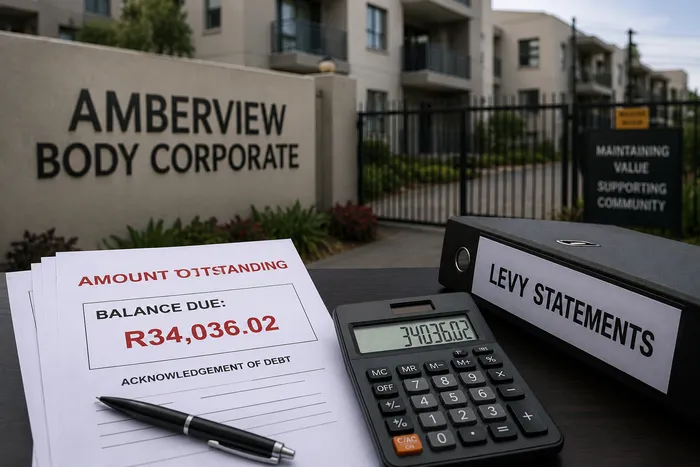
A Johannesburg homeowner has failed in a bid to derail a body corporate’s claim for more than R34,000 in outstanding levies and related charges after the High Court dismissed her exception to the claim.
Acting Judge Bongani Lubabalo Manentsa, sitting in the Gauteng Division of the High Court in Johannesburg, dismissed Elekanyani Mukondeleli’s exception against Amberview Body Corporate and ordered her to pay the body corporate’s legal costs on an attorney-and-own-client scale, including counsel’s fees, where applicable.
Dispute over R34,036 debt
The body corporate’s claim was based on an acknowledgement of debt (AOD) signed by Mukondeleli on 7 May 2025.
The claim initially reflected an indebted amount of R37,326.76. After payments totalling R3,290.74 were taken into account, the amount allegedly still owing was R34,036.02.
Mukondeleli argued that the body corporate’s particulars of claim were vague and embarrassing and alternatively failed to disclose a cause of action.
Her objections included a complaint that the body corporate had mixed legal costs and monitoring fees into the levy account, making it difficult for her to determine how the amount claimed had been calculated.
She also challenged the enforceability of the acknowledgement of debt, pointing to a clause requiring an initial payment of R3,521.43 on or before 1 May 2025, even though the agreement was only signed on 7 May 2025.A further challenge was based on a clause stating that any variation to the agreement would only be binding if recorded in writing and signed by the parties.
Judge rejects homeowner’s objections
Manentsa rejected the argument that the claim was defective because it included legal and monitoring fees.
The judge found that the claim was based on a liquid document and that Mukondeleli had undertaken, through the AOD, to pay an identified and defined indebted amount.
The court noted that there was no dispute that Mukondeleli had signed the acknowledgement of debt. Any substantive dispute about the amount or the components of the debt could be raised in her defence, but did not render the particulars of claim excipiable.
The judge also rejected the argument that the AOD was unenforceable because its first payment date preceded the date on which it was signed.
Manentsa found that the agreement was not formulated in suspensive terms and that further instalments remained due after 1 May 2025. The judge said Mukondeleli could potentially raise impossibility of performance as a defence if properly advised, but there was no basis at the exception stage to declare the entire AOD unenforceable.
No basis to strike out the body corporate’s claim
The court also dealt with Mukondeleli’s attempt to have parts of the body corporate’s claim struck out.
The application to strike out had ultimately been abandoned after the judge pointed out that the Rules of Court provide different procedures for exceptions and applications to strike out.
Manentsa found that the defendant had conflated the two procedures and that the application to strike out did not properly set out the grounds on which the impugned portions of the claim were allegedly vexatious or prejudicial.
The judge concluded that there was nothing contradictory or vague about the body corporate’s particulars of claim and that Mukondeleli was able to plead to the claim.
“There is no merit to any of the grounds of exception raised by the defendant,” the judgment states.
Homeowner ordered to pay legal costs
The body corporate had sought costs on the attorney-and-own-client scale in terms of the AOD.
Manentsa agreed that the contractual costs provision should be enforced, finding that the body corporate was entitled to its costs for successfully opposing the exception.
The final order dismissed Mukondeleli’s exception and ordered her to pay the body corporate’s costs of the exception and the application to strike out on the attorney-and-own-client scale, including the costs of counsel where counsel had been employed.