



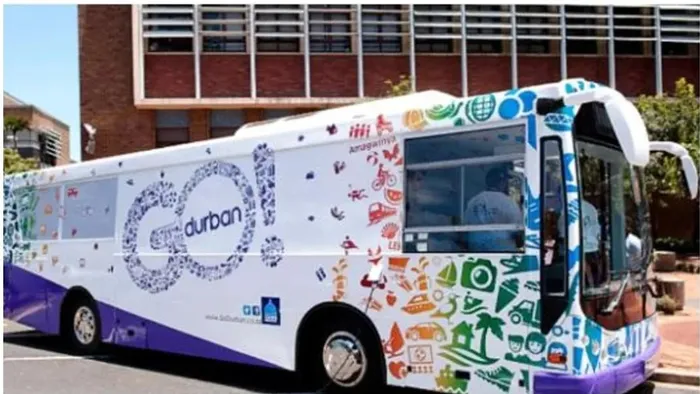
More than a decade after its launch and after billions of rand in public money have been spent, eThekwini’s troubled GO! Durban public transport project is once again under fire, with councillors questioning whether the city will ever deliver the long-promised bus rapid transit system.
The project, which was supposed to transform public transport across Durban, has become a symbol of delays, escalating costs and missed deadlines, with ratepayers left staring at empty stations and unfinished infrastructure while the municipality continues to revise implementation plans.
Frustration boiled over during Thursday’s council meeting when another GO! Durban progress report was tabled, prompting councillors from across the political spectrum to demand answers about the project’s future, affordability and value for money after years of expenditure with little visible return.
The municipality’s Human Settlements, Engineering and Transport Committee submitted a report on progress made in implementing the GO! Durban Integrated Public Transport Network (IPTN).
The report detailed developments in infrastructure delivery, operational readiness, business planning, stakeholder engagement, industry transition and institutional preparations required for the commencement of services.
ActionSA councillor Zwakele Mncwango took aim at the project, suggesting it should be renamed “Gone! Durban” because of its prolonged delays and mounting costs.
He described it as one of the city’s most expensive projects in terms of planning and delayed implementation, arguing that residents have received little in return for the money already spent.
“Ratepayers can see empty stations and no buses in operation with no return for their investment,” said Mncwango.
“This report paves the way for further expenditure with no assurance that the problems will be resolved.”
The committee provided an update on the revised corridor-based implementation strategy for Phase 1 of the GO! Durban network, with Corridor C3, linking Bridge City and Pinetown, now prioritised as the first route to become operational.
This will be followed by Corridors C1 and C9, as well as the Inner City Distribution Service (ICDS). The rollout of C2 feeder and rail-support services remains dependent on affordability, operational readiness, the recovery of Passenger Rail Agency of South Africa (PRASA) services and funding availability.
The report also outlined a review and realignment of the Operational and Business Plan in response to the winding down of the Public Transport Network Grant (PTNG).
According to the municipality, this includes aligning service levels, fleet requirements, capital commitments, operating costs, fare revenue assumptions and the city’s funding exposure with reduced grant allocations.
Officials further outlined priority actions and implementation timeframes for the next six months aimed at improving operational readiness, managing risks, finalising contractual commitments and ensuring continued compliance with grant conditions.
The municipality also reported that affected operators had been identified for Corridors C3, C1 and C9, as well as the ICDS, to facilitate compliant Vehicle Operating Company (VOC) formation and contracting.
Plans are also underway to establish a Public Transport Operations Grant (PTOG) Transition Framework and Task Team within the eThekwini Transport Authority (ETA) to oversee the absorption of legacy public transport services and operators into the municipal transport framework.
DA councillor Lyndal Singh said GO! Durban had become synonymous with delays, escalating costs, revised plans and broken promises.
She argued that the financial implications of the municipality’s revised approach remain unclear.
“Residents deserve to know why commitments and recommendations are being watered down instead of being delivered,” said Singh.
“After more than a decade and billions of rand spent, the original implementation model had to be abandoned in favour of a revised approach. It is an admission that the original strategy has failed.”
She also criticised the allocation of a further R22.9 million for another review and planning model despite concerns over previous performance.
“The municipality seems to have perfected one route: the route from the ratepayer’s pocket to another consultant’s invoice. That route appears to run exactly on schedule,” she said.
United Independent Movement (UIM) councillor Jay Singh also questioned the city’s affordability concerns, noting that approximately R9 billion has already been spent on the project.
“If affordability has become the guiding principle today, why was affordability not the guiding principle from the beginning?” he asked.
“Residents deserve to know what value has been delivered for money invested and why the project is now being scaled back to a single corridor because the original vision is no longer affordable.”