




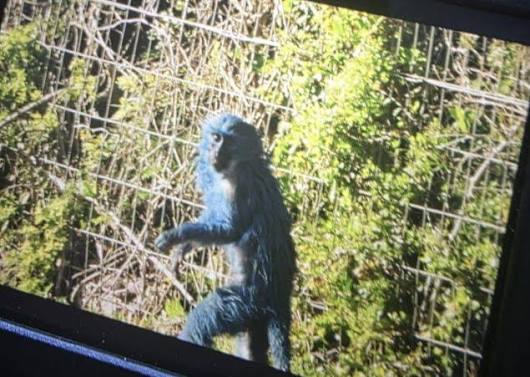
A wild monkey in Nelson Mandela Bay faces distress after being pinned down, smeared head to tail in blue paint, and released back into its troop’s territory, where it now claws and licks at the toxic coating.
So said welfare group Monkey Matters Eastern Cape, which spotted the drenched vervet in Deer Park on Sunday and said the paint could poison it and leave it facing a “slow, agonising death”.
The animal has not been caught, as it does not stay in one place long enough for rescuers to reach it, but it appeared to be doing fine, the group said.
Charne van der Mescht, the co-founder of Monkey Matters Eastern Cape, which has rescued primates in the province for more than 25 years, said the act stemmed from a belief that painting a monkey would scare off its troop.
“Some people believe if you paint them white, or now apparently blue, the troop will be scared and be chased off,” Van der Mescht told IOL on Monday.
“This is not the case and is an old myth. It is actually animal cruelty and can cause a slow, agonising death. Painting a monkey white, or any other colour, will not make its troop reject it. That is not science but ignorance dressed up as advice.”
Van der Mescht said the paint could poison the animal and damage its skin, eyes and coat, while leaving it desperately trying to clean itself.
“There is nothing brave about overpowering and painting a wild animal,” she said.
“It’s an act of cowardice against a creature that cannot defend itself.”
She said the incident had left the organisation despairing.
“We see all kinds of abuse to primates and it is heartbreaking. We work day in and day out trying to save them, and then to have something like this happen again makes us lose all faith in humanity. Primates are hit by cars, killed or injured by dogs, shot at, electrocuted and kept in tiny cages as pets. They truly have enough to deal with in facing each day with all these challenges. Humans need to start respecting our wildlife before it’s too late.”
Animal activist Marizanne Kemp Ferreira said the cruelty was disturbing.
“These animals are not invading our space,” she told IOL.
“We have expanded into theirs. They are excellent parents, intelligent, social, feeling beings trying to survive in an environment that humans have changed around them.”
Ferreira said harassing, poisoning, painting, injuring, or killing them because they exist was neither justified nor humane.
“We can and must learn to coexist with the wildlife that was here long before us. Compassion and respect for all life are the true measures of a community.”
Steve Smit, founder of the Durban-based Monkey Helpline, said the painting of monkeys was most common in KwaZulu-Natal and that the practise had, in his understanding, originated with settlers who painted baboons to protect their crops.
Smit said the belief held that a painted animal would run back to its troop, which would then flee the area, taking the crop-raiding problem with it.
Over time, he said, the practice shifted from baboons to monkeys, but the belief behind it remained false.
“This fallacy doesn’t work,” he told IOL.
“The monkey would be targeted and it would also try to clean itself. They (the monkeys) suffer immensely,” Smit said.
He said painted monkeys were sometimes also shot with pellets, and that some people treated the abuse as a joke.
“A lot of people think it is very funny,” he said.
“Everyone who does this, or thinks it is funny, should be prosecuted.”
Smit said rescued painted monkeys were always found still living among their troops, disproving the idea that the paint drove them out.
He said the practice was cruel, illegal and served no purpose.
The persecution of primates by farmers and settlers is well documented.
White settlers who spread across southern Africa generally regarded baboons as vermin and placed bounties on them, some of which remained in place well into the 1900s, according to reporting by Yale Environment 360.
Stellenbosch University historian Sandra Swart, who researches the history of baboons and humans in SA, has written that people are often far more aggressive towards primates than the primates are towards them, with the animals treated as stand-ins for wider human anxieties about intruders and safety.
The harm caused by painting is recorded in scientific literature.
A 2024 study of vervet monkey admissions to a Durban wildlife rehabilitation centre, published in the journal Mammalian Biology, documented monkeys deliberately harmed by people through physical attacks, poisoning and painting, which the authors cited as evidence of cruelty in the human-monkey conflict.
Vervets are highly social animals that live in troops and groom one another for hours a day to remove parasites and dirt, behaviour that reinforces bonds within the group.
A separate body of research has shown that female vervets remain in the territory of their birth for life, meaning troops are bonded to an area across generations and cannot simply move on when humans want them gone.
The species is protected in SA and listed as least concern on the IUCN Red List, though it is often treated as a pest in urban and farming areas, where retaliatory shootings and poisonings have been documented.
Deliberately painting or harming a wild animal is an offence under the Animals Protection Act.