




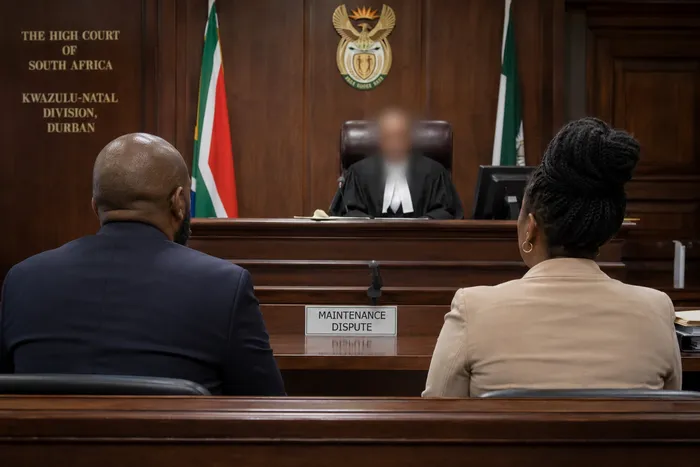
The KwaZulu-Natal High Court in Durban found a husband in contempt of court for deliberately failing to comply with an interim maintenance order during ongoing divorce proceedings.
The court sentenced him to 60 days’ imprisonment, suspended on the condition that he settled his maintenance arrears and continued to honour the court order until the divorce was finalised.
Judge Thoba Poyo-Dlwati Mathenjwa dismissed the husband’s attempt to slash his monthly maintenance obligation from more than R106,000 to just R8,000, finding that he had failed to prove any material change in his financial circumstances that would justify varying the existing Rule 43 maintenance order.
The court also ruled that his subsequent decision to unilaterally reduce his payments amounted to wilful and bad-faith non-compliance with a court order.
The dispute arises from divorce proceedings between the parties after the wife obtained an interim maintenance order in August 2022 requiring her husband to pay a monthly R120,000 while the divorce action remained pending.
Following the settlement of the bond over the family home in January 2023, the parties agreed to reduce the monthly maintenance obligation to R106,211.18, reflecting the removal of the bond repayment component.
The husband later approached the court seeking to reduce his monthly maintenance obligation to R8,000. He argued that his financial position had materially deteriorated because he could no longer rely on loans from companies and trusts associated with his business interests.
He also contended that his wife’s financial position had improved significantly after a family trust sold a property in Zimbali for R17 million, with approximately R13,8 million in net proceeds invested on behalf of the trust.
According to the husband, his salary as managing director of a construction company amounted to approximately R141,000 per month, and he had previously relied on additional funding from related entities to meet his maintenance obligations.
He argued that resolutions adopted by the company and an associated business trust ended that financial assistance, leaving him unable to continue paying maintenance at the existing level.
His wife opposed the application, maintaining that there had been no genuine deterioration in his financial position. She argued that the trust’s assets belonged to the trust rather than to her personally and therefore could not be treated as her own resources when assessing her need for maintenance. The wife also accused her husband of using the variation application as leverage to pressure her into accepting a favourable divorce settlement.
In support of her opposition, the wife pointed to evidence showing that, despite claiming financial hardship, the husband had continued to receive substantial payments.
She referred to bank records reflecting salary deposits of over R248,000 in December 2023 and over R911,000 in February 2024, arguing that these figures undermined his assertion that he could no longer afford the maintenance payments.
Judge Mathenjwa found that the husband’s reliance on his inability to obtain further loans did not amount to a material change in his financial circumstances. The judge emphasised that a person’s obligation to pay maintenance depended on their financial ability rather than their ability to secure credit.
The court further held that the wife’s access to funds from the trust did not establish that she no longer required maintenance, because those funds were recorded as loans and remained assets of the trust rather than her personal estate.
Having rejected the application to vary the maintenance order, the court turned to the wife’s contempt application.
Evidence before the court showed that, despite the existing order requiring monthly payments of R106,211.18, the husband reduced his payments to only R8,000 from December 2024 onwards. When challenged, he informed his wife through his attorneys that this was all he could afford and suggested that she instead obtain financial support from the trust.
The husband argued that his failure to comply with the maintenance order was not deliberate but resulted from a genuine inability to pay.
The court rejected that explanation.
Judge Mathenjwa found that the husband’s financial disclosures were inconsistent with the objective evidence before the court and concluded that he had not been truthful when claiming that his only source of income was his monthly salary.
The judge held that the evidence demonstrated that he continued receiving substantial amounts beyond his stated salary and had therefore failed to raise a reasonable doubt that his non-compliance was neither wilful nor in bad faith.
In considering an appropriate sanction, judge Mathenjwa concluded that imprisonment was justified but suspended the 60-day sentence until the divorce proceedings are finalised.
The suspension is conditional upon the husband paying all outstanding maintenance arrears and continuing to comply fully with the Rule 43 maintenance order. Should he fail to do so, the suspended prison sentence may be enforced.
The court also ordered the husband to pay the costs of the proceedings.