



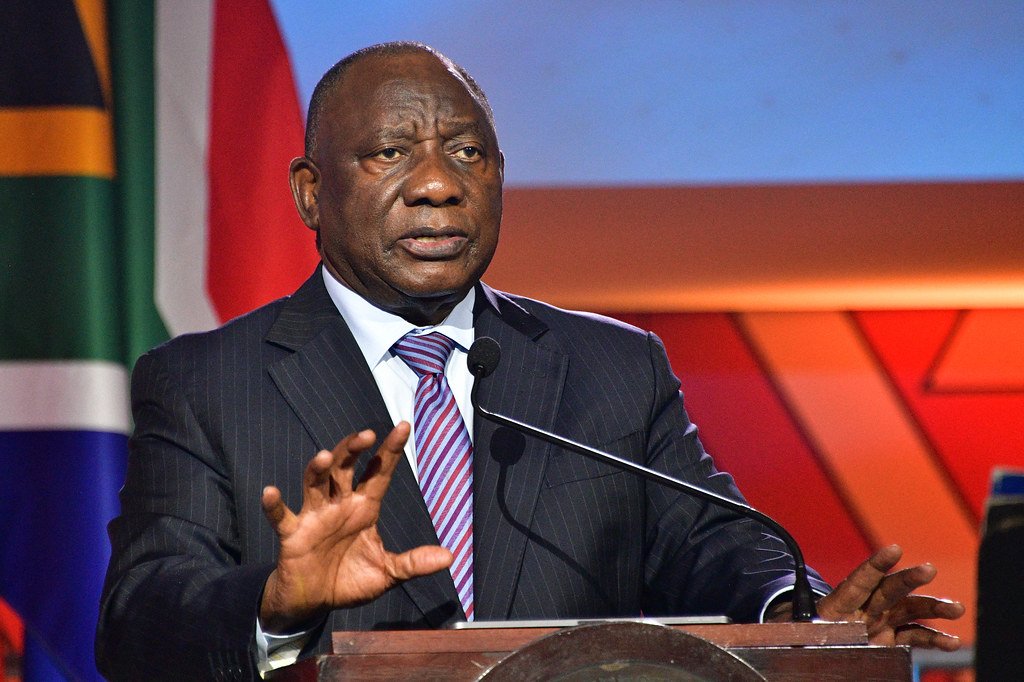
President Cyril Ramaphosa has called on Southern African countries to reduce their dependence on international markets and use the region’s mineral wealth to drive its own industrialisation.
Speaking at the University of KwaZulu-Natal in Durban on Friday ahead of the 46th Southern African Development Community (SADC) Summit, Ramaphosa said the region had the resources, skills and markets needed to build a stronger integrated economy.
“We export the ore and we import the battery,” Ramaphosa said.
“We supply an industrial revolution taking place somewhere else and we then purchase its products at a price set by others.”
He said SADC countries needed to process their own critical minerals, develop regional value chains and increase trade among themselves rather than remaining dependent on external markets.
“Our ambition should not be to catch up with other countries. Our ambition should be to build a regional economy that is unique to our circumstances and to our time,” he said.
Ramaphosa said SADC’s Vision 2050 must move from a statement of intent to a programme of action that shapes government decisions, budgets, infrastructure and skills development.
“Vision 2050 must be more than a statement of intent. It must become a programme of action,” he said.
The President said trade between SADC states remained at just under a quarter of their combined total trade, despite the region having the resources needed to produce many of the goods and services it consumes.
He said colonial infrastructure had contributed to the region’s economic fragmentation.
“Our railways were built to run to the sea rather than to each other,” Ramaphosa said.
“They were designed to carry raw minerals to destinations far afield and to bring goods produced elsewhere to our cities and towns.”
Ramaphosa called for greater investment in refining and smelting, electricity generation and transmission, water infrastructure, roads, railways and ports.
He also called for the operationalisation of the SADC Regional Development Fund to support industrialisation and infrastructure while reducing the cost of capital.
On healthcare, Ramaphosa said the region needed to reduce its dependence on imported medicines.
“We can no longer accept that we import almost everything that heals us,” he said.
He said pooled procurement could create enough market certainty to encourage pharmaceutical manufacturing in the region.
Ramaphosa also highlighted the importance of regional transport corridors, including the Maputo, North-South, Trans-Kalahari, Beira and Lobito corridors.
“These corridors must carry power, data and people,” he said.
He warned that SADC also risked repeating old economic patterns in the digital economy by exporting data and importing technology.
“Already, we are exporting data and importing intelligence,” Ramaphosa said.
Youth unemployment, he said, remained one of the biggest threats to the region’s stability and development.
“Youth unemployment is one of the gravest threats to the stability, cohesion and progress of every country in our Community,” he said.
“And it is one of the foremost obstacles to the realisation of Vision 2050.”
Ramaphosa also condemned discrimination against foreign nationals in South Africa, saying regional integration could not coexist with exclusion.
“We cannot preach integration at summits and practise exclusion in our streets,” he said.
He called for a region where people could move according to established laws and protocols while countries worked together to address poverty, conflict and other conditions driving migration.
“We seek a region where people move out of choice, not out of desperation,” he said.
On regional security, Ramaphosa described the conflict in the eastern Democratic Republic of Congo as “the gravest test of our collective resolve” and paid tribute to SADC soldiers who died while serving in the country.
He also called for stronger regional disaster preparedness as Southern Africa faces increasingly frequent droughts, cyclones and floods.
“We must act before a disaster strikes, rather than scramble for assistance after it,” he said.
Ramaphosa told students that they would ultimately be responsible for delivering the region envisioned under Vision 2050.
“The Southern Africa of 2050 we have described will not be run by those of us who will take our seats at the Inkosi Albert Luthuli International Convention Centre in the coming days. It will be run by you, the youth of our region,” he said.
“Vision 2050 is not our document. It is yours, and you are entitled to demand an account of what we did with it.”