



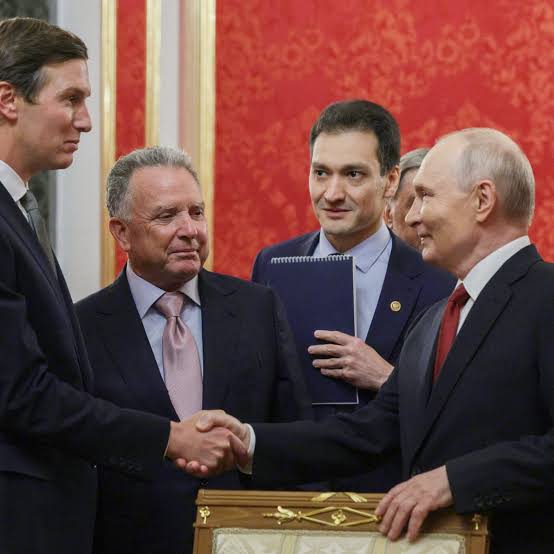
The latest visit to Moscow by Jared Kushner and Steve Witkoff has triggered a fresh wave of speculation in Russia about what Washington is trying to achieve.
With US President Donald Trump under pressure at home and much of his administration’s foreign policy bandwidth consumed by Iran, the trip has been interpreted less as a breakthrough mission than as a signal — one that may be aimed as much at domestic US politics and alliance management as at Russia itself.
Russian analysts see the visit in different ways. Some believe the Americans are simply sounding out Moscow before returning to Kiev, trying to gauge whether any room remains for movement on Ukraine. Others argue that the mission is part of a broader display of diplomatic activity by the Trump White House, intended to project momentum where little real progress is possible. Still others view it as an exercise in “shuttle diplomacy”, useful mainly for gathering information and assessing the atmosphere rather than producing concrete results.
Roman Romanov, American studies specialist and lecturer at the Faculty of International Relations, Political Science and Foreign Regional Studies at RSUH
I have two explanations for the visit and its format.
First, the American side has already shown several times that it is interested in maintaining dialogue with both Moscow and Kiev. This visit — or, rather, this tour — is aimed at “synchronising watches”.
What does that mean? The Americans are trying to understand what conditions might be acceptable to the parties for resuming an active negotiating process. In other words, they want to determine what can be offered to both sides to persuade them to move the dialogue towards progress.
The second explanation is purely domestic and political for the United States. Against the backdrop of the failure of the Iran campaign, it is necessary to demonstrate some other kind of political activity that at least theoretically resembles progress towards a concrete result. Trump has done this kind of thing more than once.
Do they have any ready-made proposals? I do not think so. First, a significant part of US foreign policy resources is currently concentrated on Iran. Second, despite the constructive role of both Witkoff and Kushner, they still act more as envoys of the US president on a specific issue than as direct participants in formulating his position.
It is difficult to explain why they went first to Moscow and then to Kiev. One can assume they first want to hear Moscow’s position because it is in a more advantageous position — Russia is advancing and winning on the battlefield — so the US believes it would be more expedient to hear Moscow’s demands first and gauge how much they have changed since August 2025, when the meeting in Anchorage took place.
At the same time, although we do not see public participation by the EU, the European Union is surely communicating its interests through closed channels. Its representatives are not there, but the position the Americans are shaping also incorporates the EU’s position.
Dmitry Dtobnitsky, Russian political scientist specialising in American studies and an expert on US foreign and domestic policy
These negotiations will continue — that is the only prospect they have.
What are we negotiating with the US about? How to stop the conflict in Ukraine? Let’s be serious. First, this conflict is much broader than Russia’s military operation. It is a geopolitical conflict with very high stakes, the kind Europe experiences once every several decades or even centuries. The Cold War period with the US was still an exception in that there were at least attempts to pursue détente from time to time.
The world has entered an era of major transformation. In that sense, asking narrowly whether they will reach an agreement on Ukraine misses the point. No.
Every time you think about that, you have to recall how it all started, why it is like this, how wrongly the world is structured, how important it is for Russia to insist on its interests and why the European bureaucracy itself cannot accept that. Otherwise, that would mean the end of both the bureaucracy and the political class in many countries.
Why can’t this conflict stop? Because it can’t be settled. Someone has to win. Just as with the US and Iran — which, incidentally, is a much more local conflict — it is impossible to agree; there can be no deal.
There can only be movement towards a situation in which one side explicitly or implicitly recognises its defeat. It may not be a total defeat, but at least at some stage one side wins and the other side does not recognise it.
Such a process will last a long time, but in the end there will still be some de facto consolidation of the results of this conflict. Unfortunately, it will not be negotiated but factual. Diplomats may formalise such a conclusion, or they may not. Frankly, that is no longer important.
When we talk about Russia-US negotiations on Ukraine, there are two extremes, and both miss the essence.
Yes, we are negotiating, and we constantly demonstrate that Russia and the US have nothing to fight over. We are ready to coexist with the US on the same globe. That is exactly why Putin says: “Of course, Kushner and Witkoff are welcome guests. Come. What else should we show you from Moscow’s kitchen?”
The US cannot conduct negotiations on Ukraine because it cannot force Kiev, London or Brussels to accept Russia’s reasonable demands. And how are they going to pressure Russia? I think the Trump administration more or less understands that it is pointless. So what kind of negotiations on Ukraine can there be?
Some say Russian Finance Minister Siluanov and US Treasury Secretary Bessent will come to some understanding and that perhaps there will be significant financial, economic or investment co-operation between the US and Russia.
I have said many times that there can be no serious co-operation between Russia and the US. There are neither material nor geopolitical grounds for it.
Are we now supposed to throw away all the achievements of localising our civilian aviation industry and start buying Boeing again? Are we going to hand over half of the most convenient Arctic territory on the planet to the US? Is that it? Or are we going to sell all Russian oil through Mr Kushner? How do you imagine that?
Some say: “Investments will come here.” But that would mean that instead of creating a sovereign financial system, we would say: “No, let’s reintegrate ourselves into the collapsing dollar system. Let’s support it with our achievements of the past five years.”
It’s obvious that there can be no real co-operation.
There can be symbolic co-operation. It is a wonderful sight when two great countries can do something together. The most we will get is a hockey match and an “Apollo-Soyuz”.
It must be understood that these are purely token steps, demonstrating that nothing particularly substantial can happen. It does not mean such co-operation will be forbidden. It simply will never play a substantial role.
Even in 2019, before COVID-19 and the military operation, trade turnover between Russia and the US was negligibly small. And that is understandable: It is geopolitics and geoeconomics — you cannot jump over that.
And now, after so much effort has been spent becoming independent and working with Eurasia on a new basis, to say, “No, now let’s start doing something again with the Americans”, is just laughable. That will not happen.
Andrey Manoylo, doctor of political science, professor at Moscow State University and head of the Department of Information and Hybrid Wars at APN Alter
Why did Kushner and Witkoff fly to Moscow for the sixth time? It’s both simple and complicated.
Kirill Dmitriev, being one of the corners of the “Anchorage triangle” — a configuration of three equidistant centres of power comprising Foreign Minister Sergey Lavrov, Kremlin aide Yury Ushakov and Dmitriev — is a red flag both for Ushakov, the “social architect” of Anchorage, and for the more sceptically minded Lavrov. That is especially true given Dmitriev’s ability to remain in the media spotlight.
That is precisely why the visit by Witkoff and Kushner — direct competitors of the “triangle’s” hard-line diplomacy — may have been planned as a simple diversion: to annoy those with whom CIA chief John Ratcliffe had contacts in Moscow and to show that the ball is now in Dmitriev’s court.
In all seriousness, though, Witkoff and Kushner did not bring anything strategic to Moscow. Their direct and, most likely, only task is to gather feedback from Ratcliffe’s visit.
Dmitriev is a gifted figure, but he is not an intelligence officer with an innate poker face, nor is he a career diplomat. Dmitriev is a living person. He is talkative, and “a chatterbox is a godsend for a spy”.
I am convinced these two are flying in with an intelligence questionnaire. They will extract all the information from Dmitriev — what people are talking about in the president’s circle, rumours and gossip, among which there will also be leaks of genuinely secret information.
Ratcliffe made a lot of noise. His visit is still agitating minds; some see him almost as a messenger of the apocalypse.
It is no coincidence that people immediately started talking about mobilisation — which in reality is “utter nonsense”, as our president said — about some secret Security Council meetings in the middle of the Shanghai Cooperation Organisation summit and even about war with Norway.
It is obvious that Ratcliffe stirred something up, and the American duo came to find out how ready that brew is. They have no other tasks.
And one more important point: What Witkoff and Kushner are doing now with Dmitriev is the well-known practice of “shuttle diplomacy”.
We know it from the events preceding the collapse of the Soviet Union. The author of the term was Henry Kissinger, who once won Mikhail Gorbachev’s trust by saying: “Gorby, while you and I are trying to break the ice of hatred, our foreign ministries, with their slowness, are ruining everything — they are slowing down the reset of our relations. Let’s push them aside and solve things directly. We are not stupider than our subordinates, are we?”
Gorbachev happily agreed, realising that by removing the Foreign Ministry from the talks, he was ridding himself of criticism — no one would contradict him.
But practice showed that the Foreign Ministry was the very mechanism that protected against hasty decisions, even if those decisions seemed correct and the only possible ones. Gorbachev lost, and together with him the entire Soviet Union lost.
And this is not the only case that confirms the rule: However attractive “shuttle diplomacy” may look, it always leads to defeat, and defeat leads to catastrophe.
Having such rich historical experience and so many examples, we still continue enthusiastically to play at “shuttle diplomacy” with Kushner and Witkoff. Why? That’s a good question.
Gevorg Mirzayan, specialist in American studies
The US began sending signals about its readiness for dialogue after Russia sharply intensified its retaliatory strikes on Ukraine and put the Kiev regime before what it sees as the inevitable catastrophe of the coming winter.
It is possible the Americans will ask us to stop, and Trump could then show voters, ahead of the congressional elections, a favourable image of his successful peacekeeping mission.
The meeting between Bessent and Siluanov at the G20 summit also fits into this scheme. No serious issues were raised there; the important thing was to demonstrate the positive attitude of the US administration towards bilateral interaction.
We are ready for peace in Ukraine, but only on our own terms — and those terms are unchanged and well known to Washington.
Yegor Tropov, political scientist specialising in American studies
The latest visit by the American negotiating delegation is primarily a symbolic step towards restoring dialogue and laying the groundwork for the future development of relations between Russia and the United States.
In the four-sided diplomatic process, it is the American side that is most interested in signing a peace document as quickly as possible — although one that would be more formal and declarative than a genuine and lasting peace.
For the sake of his media image and political role as chief mediator, Donald Trump is prepared to conduct numerous negotiations that verbally move towards peace. In reality, however, what would lead to peace is a lack of political will, finances and weapons on the part of Europe and Ukraine to continue resisting — resources they still have enough of to continue for years.
At the same time, one should not underestimate the importance of symbolism in diplomacy. Interstate communication and the establishment and strengthening of professional and personal relationships could play a much more significant role in the future, under conditions of a full-scale warming of interstate relations and the resumption of full-fledged economic and political co-operation.