



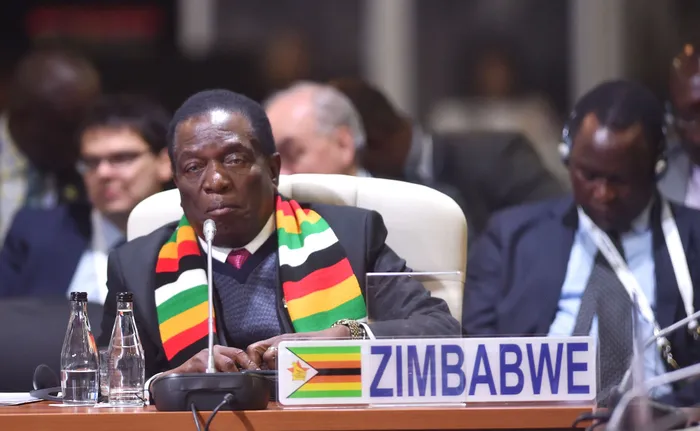
PROPOSED changes to Zanu-PF’s constitution could allow President Emmerson Mnangagwa to remain party leader after leaving State House, according to a senior party insider who disputes claims that the amendments were an attempt to remove him.
The insider, who is familiar with the party’s legal affairs process and spoke on condition of anonymity, described the proposals behind Friday’s postponed extraordinary Politburo meeting as a key and necessary transitional arrangement intended to protect Mnangagwa’s position, while creating a separate process for choosing the party’s candidate for state president.
“It is not a coup by any stretch of the imagination. It’s a transitional kind of proposal,” the insider said. “Rather than a coup against Mnangagwa, it is a soft landing for him.”
That account challenges competing versions circulated by political activist Jealousy Mawarire and former Norton MP Temba Mliswa. Their claims have fuelled debate about the proposed amendments and their implications for Zanu-PF’s succession contest.
At the centre of the dispute is a consequential question: should becoming Zanu-PF president automatically make someone the party’s candidate to lead Zimbabwe?
The extraordinary Politburo meeting scheduled for Friday, 9 October, was postponed amid conflicting accounts of what had happened and why.
In a widely shared post on X, Mawarire claimed Vice President Constantino Chiwenga had intervened to stop the meeting because the proposed changes rested on an unlawfully amended national constitution.
The NewsHawks separately reported that the meeting had been cancelled following fierce clashes between Mnangagwa and Chiwenga.
Mliswa offered a different explanation a day later. In comments reported by ZimEye, he alleged that a “Gang of Four” led by Justice Minister and Zanu-PF Secretary for Legal Affairs Ziyambi Ziyambi had attempted to introduce far-reaching changes without Mnangagwa’s knowledge.
“He was creating two centres of power,” Mliswa said, arguing that the proposals would separate the party presidency from the state presidency.
The insider rejected both accounts, saying the meeting had been postponed before it began.
“It is false that there was a meeting. It is false that the meeting was stopped by Chiwenga. It is false that Chiwenga said anything there of the kind attributed to him,” the insider said.
According to the source, Mnangagwa, who chairs the Politburo, had not entered the room. ZimLive also reported that the meeting was called off before the President joined it.
These accounts differ materially. One describes a confrontation during a meeting; the other says the meeting never formally began.
According to the insider, Zanu-PF’s existing constitution automatically makes the person elected party president and first secretary at Congress its candidate for state president.
The proposed amendment would remove that automatic nomination.
Instead, the source said, a prospective presidential candidate would need support from at least six of the party’s 10 Provincial Coordinating Committees, endorsement by the Central Committee and a declaration by the annual National People’s Conference.
Congress would continue to elect the party president.
“It doesn’t establish two separate offices,” the insider said. “It establishes two separate ways of choosing the leaders of the two different offices of party leader and state president.”
Under that interpretation, the same person could still lead both the party and the country. The change would also allow Congress to retain one person as party president while the party nominates someone else for the state presidency.
The insider argued that Mliswa’s account confused the existence of two offices with the creation of rival authority within the party.
However, the distinction would have real political consequences. Removing automatic nomination would mean that winning the party presidency would no longer, by itself, secure Zanu-PF’s presidential ticket.
The insider said the proposals should be understood against the different rules governing leadership of a political party and tenure as head of state.
Zanu-PF’s constitution, the source said, does not impose a term limit on its president and first secretary. A leader who could no longer serve as Zimbabwe’s president after serving two terms as state president could therefore remain at the helm of the party if Congress re-elected him.
To illustrate the point, the insider cited Thabo Mbeki’s unsuccessful bid for a third term as ANC president at the party’s Polokwane conference in December 2007.
Mbeki sought another term as party leader, because the ANC constitution has no term limit, even though South Africa’s Constitution prevented him from serving a third term as president of the country. He lost the party contest to Jacob Zuma.
“He could have won, theoretically. And had he won, he would have been president of the ANC, but he would not have qualified to be President of the Republic of South Africa,” the insider said.
“So he would have been president of the ANC, but someone else would have been president of South Africa.”
The source said the proposed Zanu-PF arrangement would create a comparable possibility: Mnangagwa could retain the party presidency in 2029, while another party candidate sought the state presidency in 2030.
The insider described the proposed arrangement as the “Nyerere way”, drawing a comparison with Tanzania’s founding president, Julius Nyerere.
Nyerere stepped down as head of state in November 1985, handing over to Ali Hassan Mwinyi, but remained chairman of the ruling Chama Cha Mapinduzi until 1990.
For several years, Tanzania’s presidency and the leadership of its ruling party were therefore held by different people.
The insider argued that this offered a model for a managed and stable transition in Zimbabwe, allowing Mnangagwa to leave the state presidency after completing his two terms in 2030, while retaining a senior political role as Zanu-PF president.
“It explains very well what the proposed amendment seeks to achieve and puts paid to the nonsense that it is a coup against Mnangagwa,” the source said. “It’s actually in favour of Mnangagwa in the party and national interests, not a coup against him.”
The insider contrasted that approach with Robert Mugabe’s removal in 2017, arguing that a managed constitutional transition could help Zanu-PF avoid another rupture.
That remains the source’s interpretation of the proposals. It does not establish that the party has agreed on such an arrangement or that Mnangagwa has committed to it.
The source also challenged Mliswa’s portrayal of Ziyambi as the driving force behind an attempt to undermine Mnangagwa.
Mliswa is a former Zanu-PF provincial chairman in Mashonaland West who was expelled from the party in 2015. He later represented Norton in Parliament as an independent.
“Mliswa is not a Zanu-PF insider. He is a former Zanu-PF insider,” the source said.
“Normal people would take what a former Zanu-PF insider says about Zanu-PF not just with a pinch of salt, but probably a bag of salt.”
The insider argued that Ziyambi’s relationship with Mnangagwa made the suggestion of an unauthorised constitutional overhaul implausible.
“You will not find anyone serious in or outside Zanu-PF who thinks Ziyambi is a political gladiator. He’s one of the President’s men, he is one of seven cabinet ministers appointed by Mnangagwa outside Parliament, so he has no political constituency besides the President,” the source said.
“Ziyambi can’t bring proposed amendments to the Zanu-PF constitution to the Politburo which he has not shared with the President, briefed the President on, or gotten a nod from the President on.”
The source also disputed the allegation that the proposals had been secretly introduced.
“How do you smuggle amendments to the party’s constitution by putting them in a paper and presenting the paper to the Politburo for debate and approval or rejection?”
Those comments challenge Mliswa’s account, but they do not independently establish what Mnangagwa had seen or approved before the scheduled meeting.
Beyond the conflicting accounts of Friday’s events, the proposed changes could reshape the route to Zimbabwe’s highest office.
Under the system described by the insider, anyone seeking the state presidency would have to secure support through several party structures rather than rely solely on victory at Congress.
The source said this would inconvenience politicians-cum businessmen who have shown a predisposition to use their money to buy political power, hoping to win the party presidency and automatically inherit its presidential nomination.
“This proposal removes that automatic thing, and that’s a problem for them,” the insider said.
The practical effect would be to separate two contests that have previously been linked: the contest to lead Zanu-PF and the process of choosing its candidate to lead the country.
It could also give provincial structures, the Central Committee and the National People’s Conference a more explicit role in selecting that candidate.
Whether this would produce a stable transition or fresh competition between party and state leaders remains an open political question.
The insider also alleged that Mliswa was speaking on behalf of a prominent businessman with an interest in Zanu-PF’s succession contest, and that the party’s secretary general, Jacob Mudenda, had aligned himself with that businessman.
These allegations have not been independently verified.
According to the source, opposition to the proposals extends beyond the presidential nomination process to a separate plan to professionalise the party’s administrative staff under a director general.
The insider alleged that Mudenda viewed the proposed administrative changes as a threat to his authority as secretary general.
Mliswa’s public comments also identify the director general proposal as a point of contention. He told ZimEye that the arrangement would make the director general more powerful than the secretary general, asking: “How can the shareholder be told what to do by a worker?”
The insider further alleged that Mudenda, who convenes Politburo meetings as secretary general, initiated arrangements for Friday’s meeting while he was in Tanzania, then began mobilising against the proposed amendments after receiving them.
“It’s an abuse of your office, as a recipient of the proposals, to look at them and start organising against them outside the normal structures of the party,” the source said.
The insider characterised the opposition to the proposed amendments as an attempt to discredit a transitional arrangement by portraying it as a plot against Mnangagwa.
“It’s actually a transitional proposal that seeks a transitional arrangement that would stabilise the party and the country,” the source said.
The competing accounts expose a dispute over both succession and control of the party’s administration: who chooses Zanu-PF’s presidential candidate, who manages its machinery and how authority is divided between elected leaders and professional staff.
The insider said the constitutional review began with resolutions from Zanu-PF’s Provincial Coordinating Committees calling for the party constitution to be aligned with changes to the national constitution.
The party’s Department of Legal Affairs then held a three-day workshop to develop the draft proposals with the knowledge and approval of both Mudenda and the President, the source said.
“The call for the alignment of the party constitution has not come from the Politburo. It has not come from the Secretary for Legal Affairs. It has come from provinces,” the insider said.
“It’s a common cause; it’s been in the media.”
The NewsHawks reported that Ziyambi confirmed in late September that the party’s Legal Standing Committee had been instructed to prepare the alignment ahead of the Chinhoyi conference.
The party debate follows the enactment of the Constitution of Zimbabwe Amendment (No. 3), which extended presidential and parliamentary terms from five to seven years and replaced direct presidential elections with selection by Parliament.
Parliamentary records confirm that the legislation passed through both Houses and that consequential amendments were being considered following its enactment.
The changes have intensified scrutiny of Zimbabwe’s succession arrangements and the relationship between Zanu-PF’s internal rules and the national electoral system.
According to the insider, the postponed Politburo meeting would still take place. The party’s 23rd National People’s Conference is scheduled to run from 12 to 17 October at the Chinhoyi University of Technology.
Neither Mnangagwa nor Chiwenga has publicly explained the postponement, according to the supplied reporting.
For now, the insider’s account offers a competing explanation for the disputed proposals: a route through which Mnangagwa could eventually leave State House while retaining the party leadership.
Whether Zanu-PF accepts that arrangement, and how those seeking to succeed him respond, will determine whether the proposed “soft landing” eases the succession contest or deepens it.