



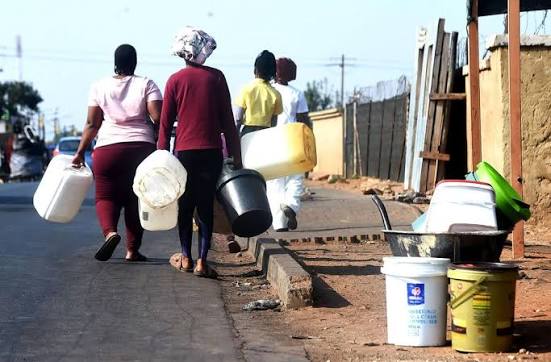
South Africa’s worsening water crisis is being driven less by a lack of infrastructure than by weak governance, poor financial management and municipalities’ inability to generate revenue.
This is according to DNA Economics’ Practice Head: Climate and Public Economics, Shirley Robinson, who highlighted that municipal water infrastructure finance is fundamentally a municipal finance challenge.
Robinson shared her insights during a “Beyond Infrastructure: Financing South Africa’s Water Future” webinar on Monday, which gathered experts to challenge the current conversation by shifting the focus from infrastructure deficits to financial ability.
The webinar, moderated by visiting British Academy research fellow Dr Ohiocheoya Omiunu, was hosted by the South African Institute of International Affairs (SAIIA) in partnership with DNA Economics, GreenCape and the Infrastructure Finance and Implementation Support Agency (IFISA).
Robinson explained that the discussion around water infrastructure financing always begins with the question of how the required investment will be financed, but that it should first start with what makes a municipality capable of sustaining long-term infrastructure investment.
She said that the country’s water system comprises several interconnected systems.
“National government is responsible for strategic water infrastructure, through the water board, including dams, and major transfer schemes. Water boards develop and operate many of these regional bulk water treatments and conventional systems that supply municipalities.
“Municipalities, however, are responsible for the infrastructure that’s required to provide the water and sanitation services directly to us as customers and consumers,” she said.
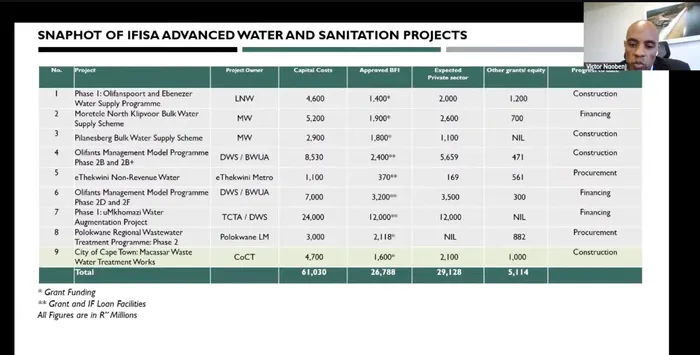
Image: Screenshot
She said that each part of the water sector has different institutional responsibilities, financing and risk profiles.
“Municipal water infrastructure finance is fundamentally a municipal finance challenge, but more fundamentally, it is a systems challenge.
“Finance rarely fails because capital is unavailable… It fails because the institutional conditions required to absorb, manage and sustain the investment have not been established,” Robinson said.
She explained that projects do not succeed or fail in isolation, but rather succeed or fail within planning systems, budgeting systems, revenue systems, procurement systems, asset management systems and governance systems.
“When those systems function well, finance can flow. When they do not, the market failure comes through; even well-designed projects struggle to be bankable.”
Robinson added that the biggest obstacle to financing municipal water infrastructure is not the availability of capital, but “the financial condition and the institutional capability of the municipality or the sponsor that is expected to plan, finance, procure, operate, maintain, and renew that infrastructure over the next 20 to 30 years”.
Image: supplied
She also highlighted that the National Treasury’s recent decision to temporarily withhold the July Equitable Share Transfers to 69 municipalities serves as a reminder that municipal financial governance directly affects institutional credibility, service delivery, and investment readiness.
“This creates a fundamental paradox. South Africa’s water and municipal water infrastructure requires significant investment to rehabilitate ageing assets, reduce water losses, expand services to a growing population, and strengthen resilience to climate change.
“Yet many municipalities are simultaneously experiencing decline, revenue collection, growing creditor obligations, weak liquidity, ageing infrastructure, rising maintenance backlogs, and constrained fiscal positions.
“The municipalities with the greatest infrastructure needs, paradoxically, are often those that are the least able to attract the finance,” Robinson said.
“Bankability is not a characteristic of a financing instrument. It’s a characteristic of the enabling environment within which the investment takes place. Bankability begins long before a municipality approaches a lender. It begins by building financial, sustainable institutions, credible governance systems and well-prepared projects.”
Robinson highlighted that not all municipalities start from the same place or follow the same path to bankability, as they individually have to determine which financing instruments are appropriate.
GreenCape Technical Specialist: Green Finance and Water Sector, Raldo Kruger, added that: “Any discussion around municipal creditworthiness has to have a starting point in terms of what is the current status of investment, and highlighting this historical underinvestment in infrastructure and the huge need to accelerate investment in infrastructure – in particular in the context of building climate resilience.
“Municipalities lose roughly 35% of the water that enters the municipal water system due to leakages and losses. These 2019 figures translate to around R10 billion in lost revenue for municipalities across the country. It really kind of highlights that massive need for solving for investment in infrastructure in municipalities in South Africa,” he said.
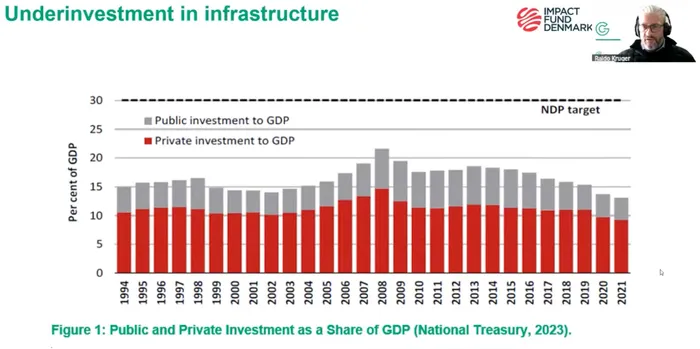
Image: Screenshot
When looking at what municipal creditworthiness is, Kruger said: “It’s really the confidence that providers of capital will have that their investment is safe and that they’ll be able to get a return on their investment.
“The pillars that affect that really revolve around governance, revenue management, and expenditure management… If you look at these three pillars, particularly around increasing revenue and reducing costs, they are all underpinned by good governance, leadership and future planning – those are really the key pillars of creditworthiness.
“And so, without creditworthiness, coming back to the question, why is creditworthiness important? Without creditworthiness, municipalities are going to find it very challenging to stimulate economic growth within their municipality through investment in infrastructure.


![South Africa responds to claims of cooperating with Iran on nuclear energy [VIDEO]](https://newsunplug.co.za/wp-content/uploads/2025/02/Koeberg-1-480x320.jpg)