



The uMkhonto weSizwe (MK) Party has moved to distance itself from former president Jacob Zuma’s controversial visit to India, insisting the trip was a private engagement and had nothing to do with the party.
The clarification comes after Zuma travelled to the northern Indian state of Uttarakhand in late June, where he was photographed alongside Ajay Gupta at the Siddhpeeth Shri Dakshin Kali Mandir in Haridwar.
Ajay Gupta is one of the Gupta brothers linked to allegations of state capture in South Africa and remains wanted by South African authorities.
Indian media reported that Zuma was accompanied by Gupta, who was described as a disciple of the ashram, as well as South Africa’s High Commissioner to India, Professor Anil Sooklal.
The images have reignited scrutiny over Zuma’s long-standing relationship with the Gupta family and prompted fresh questions about the nature of the visit.
During his trip, Zuma also made political remarks, telling reporters that he believed he would return to power and was confident of winning future elections because “the people of God” had stood by him.
Zuma also reflected on his time as president, saying he was pleased to be visiting India “at the right time” and recalling that he had once led South Africa before being removed from office.
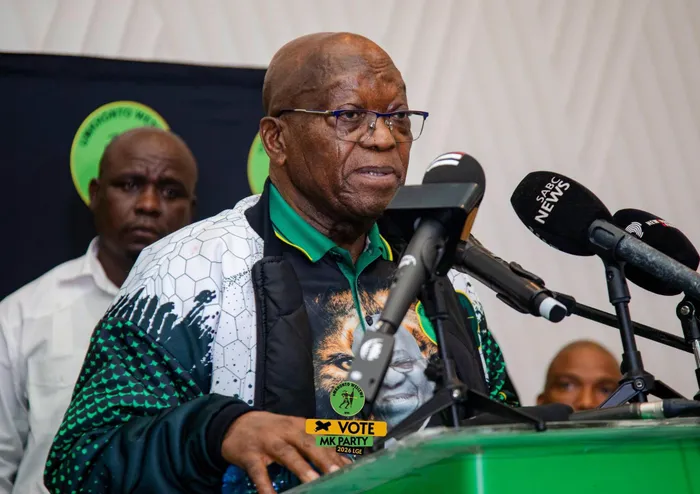
In an interview on Newzroom Afrika, MK Party secretary-general Sibonelo Nomvalo said Zuma’s visit was a private matter and that the party should not be held responsible for his personal activities.
“We have responded to that question. We said the trip to India was a personal visit by the president. The fact that he’s the former head of state does not preclude him from visiting any area in the world, so he went there to visit, and it was a private visit,” Nomvalo said.
Nomvalo said Zuma’s position as a former president did not prevent him from travelling or meeting people of his choice.
He said individuals were entitled to privacy and that the party could not be expected to account for Zuma’s private engagements.
“Everyone has a freedom to privacy. Next time you will ask us what people do when they are in a restroom and we must be accountable for that,” Nomvalo said.
Nomvalo said Zuma’s visit was unrelated to the MK Party and should be viewed as a personal engagement.
“A trip to India is a trip of President Zuma, he went there to attend or to visit some leaders of a religious society in India. So we’ve got nothing to do with that as the party,” he said.
The Gupta family, including Ajay and Atul Gupta, became central figures in allegations of state capture during Zuma’s presidency. They have denied wrongdoing.
Meanwhile, International Relations and Cooperation Minister Ronald Lamola said Zuma’s engagement in India reflected negatively on South Africa and appeared to amount to a “parallel foreign policy”.
Lamola said the department was investigating the circumstances surrounding the visit, including how it was facilitated, its purpose and whether there were any implications under the Foreign Service Act.
“It does impact us negatively that the former head of state will be running a parallel foreign policy to the South African government,” Lamola said.
He said former presidents were entitled to certain privileges, including assistance through diplomatic protocols, but those privileges did not extend to representing the government abroad.
“We must state that while the Presidential Act does allow privileges to flow to former presidents, it does not allow them to run a parallel foreign policy, which seems to be the case now with former President Zuma,” Lamola said.